

TL;DR: Summary
Polyiso: The most common choice when space is limited. It offers the highest R-value per inch (R 5.6–6.5), though its performance can drop in temperatures below 40°F.
XPS: A dense, moisture-resistant board (often pink or blue) that is great for durability, but loses about 10–15% of its R-value over its first few years.
EPS: The most budget-friendly option. It has a stable R-value that never degrades, but it is bulkier and requires more thickness to achieve the same thermal protection as Polyiso.
Are you worried your roofer may have installed the wrong kind of insulation for Seattle’s wet, chilly climate? Are you trying to research which types of insulation are best for flat roofs, but getting frustrated because they all seem so similar?
You’re not alone. If you aren’t familiar with flat roof insulation types (like polyiso, XPS, and EPS), then it can be difficult to tell how each one is different and why those differences even matter.
At RoofSmart, we’ve replaced hundreds of flat roofs all over the Greater Seattle area. By far the most common issue we see is condensation that rots the roof because the previous roofer didn’t insulate the roof properly.
In this article, we’ll walk you through the three main insulation types used on flat roofs in Seattle (polyiso, XPS, and EPS) and help you understand the pros, cons, and hidden risks of each one. You’ll also learn what to consider when choosing insulation and how to avoid the costly mistakes most roofers make.
What are the most common types of insulation used in Seattle roofs?
Flat roofs need to be insulated differently from regular sloped roofs, so their insulation looks a little bit different. The three main types of flat roof insulation used on Seattle homes are polyiso, XPS, and EPS.
One way to measure the differences between the insulation types is by discussing their R value. The R value is how you measure insulation value (how well the insulation works). It generally ranges from R0 to R60. In Seattle, you need to have a minimum of R10 above the deck to prevent condensation.
Here’s an overview of the pros and cons of the three main kinds of flat roof insulation:
Polyiso (Polyisocyanurate Insulation)
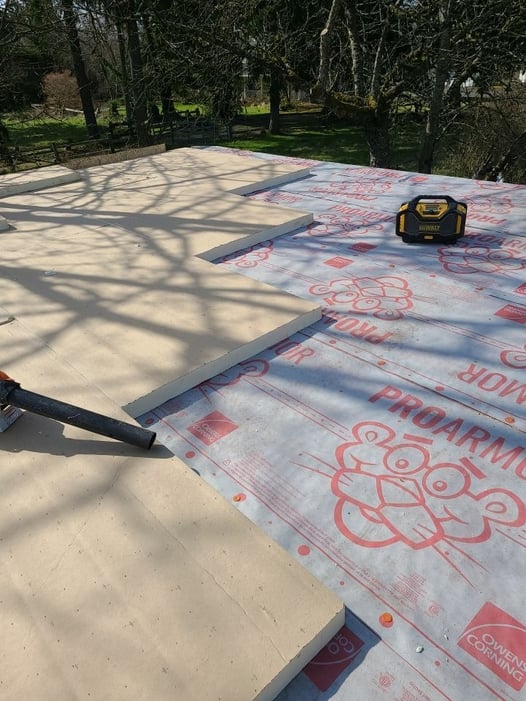
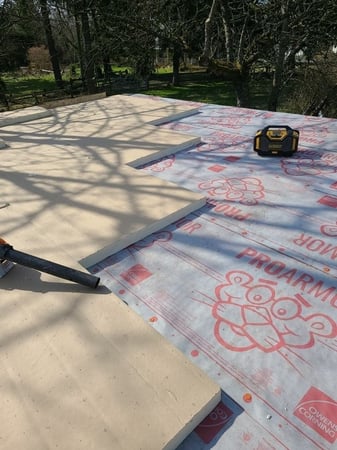
What it’s made of: Polyiso is a closed-cell rigid foam board made from polyisocyanurate plastic, typically faced with fiberglass mats (glass fiber facers).
What it looks like: Rigid boards with a tan or yellow foam core and gray or white fiberglass facings on both sides. It does not look like Styrofoam.
Pros
- Highest R-value per inch among common rigid foam insulations (R value per inch is 5.6 – 6.5 initially and then around 5.0 when aged)
- Class A fire-rated roof assemblies
- Performs very well in warm or hot climates
- Widely available
Cons
- R-value drops significantly in cold temperatures (below ~40°F)
- Performance loss is a concern in cold, damp climates like Seattle
- Cannot be vented in flat roof assemblies, increasing condensation risk if not designed correctly
XPS (Extruded Polystyrene Insulation)
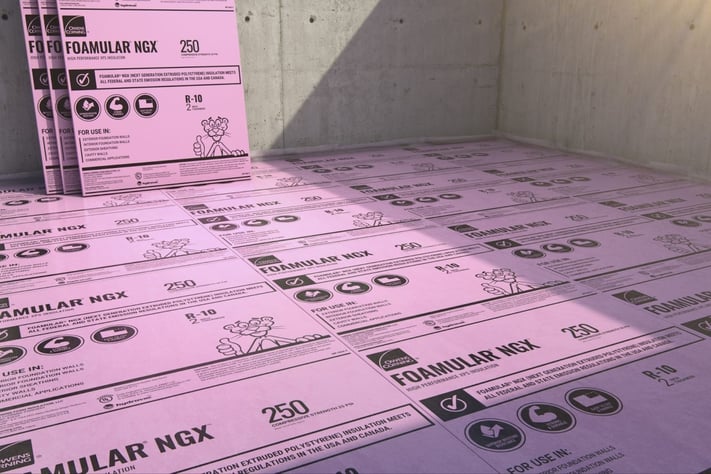
Image from Rural Builder
What it’s made of: XPS is a closed-cell plastic foam made by extruding polystyrene with blowing agents to create a dense, uniform board.
What it looks like: Smooth, rigid foam boards (most commonly blue, pink, or green) with a tight, closed-cell appearance.
Pros
- High initial R-value, close to polyiso when new (R value per inch is 4.7 – 5.0)
- Performs well in below-grade and foundation wall applications
- Resists moisture absorption better than many other foams
- Suitable where durability and load resistance matter
Cons
R-value degrades about 10–15% in the first few years, then stabilizesLong-term thermal performance is lower than its initial rating
- R-value degrades about 10–15% in the first few years, then stabilizes
- Long-term thermal performance is lower than its initial rating
- Less eco-friendly
- Similar cost to polyiso, despite long-term R-value loss
EPS (Expanded Polystyrene Insulation)
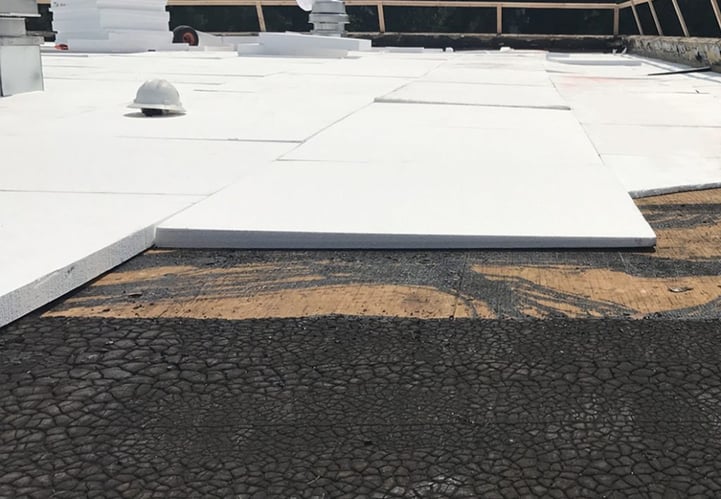
Image from Insulfoam
What it’s made of: EPS is made from expanded polystyrene beads that are molded together using steam. It contains small air pockets rather than a continuous closed-cell structure.
What it looks like: White foam board that resembles Styrofoam, though it is denser and engineered specifically for construction use.
Pros
- Stable R-value that does not degrade over time
- Lower cost per unit of R-value compared to polyiso and XPS (R value per inch is 3.6 – 4.2)
- Dense EPS is rigid and can be very durable
- Performs consistently in cold climates
Cons
- Lowest R-value per inch of the three options
- Requires significantly more thickness to reach higher R-values
- Not ideal where space is limited
- Wide variability in formulations (12+ types), making specification important
- Can be bulkier compared to polyiso
Does it matter what kind of insulation my roofer uses?
All three of these are vapor barriers. This means that they are an impermeable, closed-cell foam that prevents moisture from collecting on the roof decking and rotting it.
So, how do you decide which one is best?
Three factors can help you decide which type of insulation is right for you:
- Material costs: Polyiso is the most expensive material, while XPS and EPS cost about the same. It’s tricky to make your decision based only on material costs. No matter which one you choose, adding insulation to your flat roof adds a lot to the cost due to extra materials (and labor).
- Labor costs: Labor costs are unavoidable, so unless it's a very large project, the difference in cost is usually not significant. But if you build the roof up an extra few inches, you have a whole lot of extra trim work to do. This means additional labor costs. You can avoid some of these extra labor costs by choosing a thinner material, like polyiso, but it’s more expensive anyway.
- How much room you have to work with: Often, when you’re adding insulation to your roof, it’s going to add a few inches to the height of the roof. So if building up the assembly, you know, an extra few inches isn't going to matter, then EPS or XPS is probably going to be the best choice. But if space is at a premium (and it usually is), polyiso is the common choice, even though it's a more expensive material.
At the end of the day, you can pick any of the insulation options, and they would all work fine (as long as they’re properly installed). There isn’t one that works way better or worse than the others.
How much will the right flat roof insulation cost you in Seattle?
Now that you understand how critical insulation is to the long-term health and performance of your flat roof, you're probably wondering what it’s actually going to cost to get it done right.
Material choice, labor, and the layout of your roof all play a big role in determining the final price, and the last thing you want is to overspend or underinsulate.
So how much should you expect to budget for a properly insulated flat roof in the Seattle area?
Read our article “How Much Does It Cost to Install a Flat Roof in Seattle?” to explore the real costs of flat roof installation in Seattle, including insulation options, labor breakdowns, and what factors affect your total price.
Frequently Asked Questions
1. Why is flat roof insulation different from regular attic insulation?
Standard sloped roofs use fiberglass or cellulose in an attic "floor." Flat roofs are typically unvented, meaning the insulation must be rigid foam installed directly on top of the roof deck to keep the structure warm and prevent condensation.
2. What is an R-value, and what is required in Seattle?
The R-value measures how well insulation resists heat flow. For flat roofs in Seattle, you need a minimum of R-10 above the deck to keep the dew point outside of your structural wood and prevent mold and rot.
3. Does Polyiso insulation work less effectively in the winter?
Technically, yes. Polyiso’s R-value drops when temperatures fall below 40°F. However, because it is so thin and widely available, it remains the standard choice for Seattle roofers who need to keep the roof profile low.
4. Is EPS (Expanded Polystyrene) just like Styrofoam?
While it looks like the white foam used in coolers, construction-grade EPS is much denser and engineered for load-bearing. Its biggest advantage is that its R-value is stable and will not degrade over the life of the roof.
5. Why is XPS (Extruded Polystyrene) often used in foundations?
XPS is highly moisture-resistant and handles pressure well. On a roof, it is a great mid-range option, though its R-value "off-gasses" and stabilizes at a lower rating a few years after installation.
6. Will adding insulation make my roof taller?
Yes. Adding the required R-value can add 2 to 5 inches of height. This often requires extra labor to adjust door thresholds, siding, and trim work to match the new roof level.
7. Is Polyiso the most expensive material?
Generally, yes. Polyiso has the highest material cost, while XPS and EPS are usually more affordable. However, the labor to install them is similar regardless of the material type.
8. Can I just skip the insulation to save money?
Skipping insulation on a flat roof is a recipe for disaster in Seattle. Without it, warm air from your home will hit the cold roof deck, causing condensation that can rot your roof from the inside out in just a few seasons.
9. How do I know if my roofer is using the right insulation?
A qualified roofer should provide a detailed proposal specifying the type (Polyiso, XPS, or EPS) and the thickness they plan to install to meet local energy codes.
10. How much does an insulated flat roof cost in Seattle?
Because of the technical requirements and material costs, an insulated flat roof is more expensive than a standard shingle roof. You can find a full price breakdown in our guide: How Much Does It Cost to Install a Flat Roof in Seattle?
Topics:
