

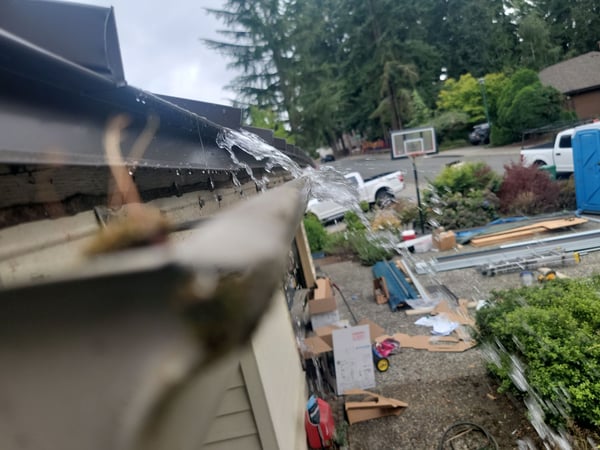
Did you put gutter guards on your steep roof, and now you watch water pour over the front of the gutter every time it rains hard? Are you starting to wonder whether any guard can keep up with water coming off a roof that steep?
Here's the frustrating part. The gutter isn't plugged, but the water still isn't going in. That water ends up against your fascia, your siding and your foundation, which is exactly what gutters are supposed to prevent.
At RoofSmart, we've been working on Seattle-area roofs since 2011. Every year, that's 1,000+ roofs serviced and 500+ full replacements, and we hold 14 manufacturer certifications and are MasterShield's exclusive certified installer, so we see what different gutter guards do on steep roofs every season.
In this article, I'll explain what a gutter guard is really guaranteed to do, why steep roofs make water overshoot, which two guards we recommend for steep roofs, and the cheapest way to fix overshooting if a guard is more than you need.
Quick Answers
- Most gutter guard warranties promise to stop clogs, not to catch the water. On a steep roof, water comes off fast enough to shoot right past many guards.
- We recommend two guards for steep roofs: Leaf Relief and MasterShield. Both take the water, but Leaf Relief can splash on a really steep or metal roof.
- If water overshoots in only a spot or two, a simple diverter at that corner is the cheapest fix. If you have clogging and overflowing too, that's when MasterShield makes sense.
- Disclosure: RoofSmart is MasterShield's exclusive certified installer.
What does a gutter guard actually promise to do?
The gutter guard warranties we checked promise to stop clogs in the gutter, not to catch the water or prevent clogs in the gutter guard. And on a steep roof, catching the water is the part homeowners actually care about. So before you ask whether a guard works, it helps to ask what "work" means.
To the manufacturer, it means debris stays out, and the gutter doesn't plug. To you, it means the water coming off your roof flows into the gutter and out through the downspout. A guard can prevent your gutter from clogging but still have other issues (like clogged guards and overflowing water).
In other words, the gutter guard works the way they define it, just maybe not the way you do.
Do gutter guard warranties cover water that misses the gutter?
Usually not. The gutter guard warranties we checked cover clogging, not whether the water makes it into the gutter. As I put it: "None of these gutter guards guarantee the water goes into the gutter. They only guarantee that if water goes into the gutter, it won't overflow."
LeafFilter's warranty registration page says that, when professionally installed, its system "prevents debris from entering or clogging the gutter's interior." Ply Gem's Leaf Relief 25-year limited warranty covers overflow caused by debris clogging the gutter or downspouts. MasterShield's warranty page calls its coverage a "lifetime warranty," and its homepage calls it a "no clog warranty" that's "fully transferable."
I've seen a homeowner's video where the guard wasn't plugged at all, and the water still wasn't going in. By the warranty's terms, nothing was wrong. We dig into the fine print in what gutter guard warranties really cover.
Why does water shoot past gutter guards on a steep roof?
Gravity speeds water up as it runs down a steep roof, so it reaches the gutter edge moving fast enough to bounce off or fly past a guard that sits flat. The steeper the roof, the faster it's coming off, and it doesn't just shoot past. It bounces.
That's a lot of water moving fast in a Seattle downpour, and not many guards were built to take it. MasterShield explains the same problem from the manufacturer's side on its HydroVortex page: in heavy rain, water can carry right past the front lip of many guards even when nothing is clogged. Keep in mind that we install MasterShield, so that's a manufacturer we work with talking.
Do gutter guards work on a steep metal roof?
Some do, but water runs off a smooth metal roof even faster than off shingles, so the guard has to be one that can handle fast-moving water, sometimes in large amounts, and splashing is more likely. On a steep metal roof in a heavy rain, that water is flying down the roof.
Our guide to roofing on a steep slope notes that metal roofs can shed water very quickly on steep slopes and may need larger gutters and guards that can handle the runoff. This Old House makes a similar point in its gutter splash guard guide, listing a steep roof pitch, heavy rainfall, and a metal roof as the conditions where splash guards can help.
Which gutter guards work on steep roofs?
The two we recommend for steep roofs are Leaf Relief and MasterShield, because both will accept fast-moving water. They take it in very different ways, and that difference matters on a really steep roof.
RoofSmart is MasterShield's exclusive certified installer. We also install Leaf Relief.
| Leaf Relief | MasterShield | |
|---|---|---|
| What it is | A perforated plate, like a colander or a cheese grater | A micro-mesh filter with MasterShield's HydroVortex design |
| Steep-roof downside | Heavy, fast water can splash where it hits the solid part | Costs more than simpler fixes, and it's overkill for overshooting in a spot or two |
How does MasterShield catch fast-moving water?
MasterShield sits at the pitch of the roof, and its HydroVortex design pulls water through the filter as it flows, so faster water still ends up in the gutter. MasterShield calls HydroVortex "a patented filtration feature."
If you don't want the details, skip this paragraph. The way I understand it, there's a math ratio between how thick the filter threads are and how far apart they sit. If they’re too far apart, then debris gets through, but if they’re too tight, then the water clings and won't pass. If you get it just right, the water grips and speeds up through the filter. The more it does it, the better it works.
Our MasterShield gutter guard review covers the rest of the product. Here, I'm sticking to how it handles a steep roof.
Can MasterShield go on a very steep roof pitch?
Yes. MasterShield installs at the same angle as the roof, on pitches from 22.5 to 75 degrees. Because it follows the roofline, the water doesn't have to drop onto it from the roof edge. MasterShield's HydroVortex page says the same thing: water "comes off the shingle and slides directly onto the guard without ever dropping."
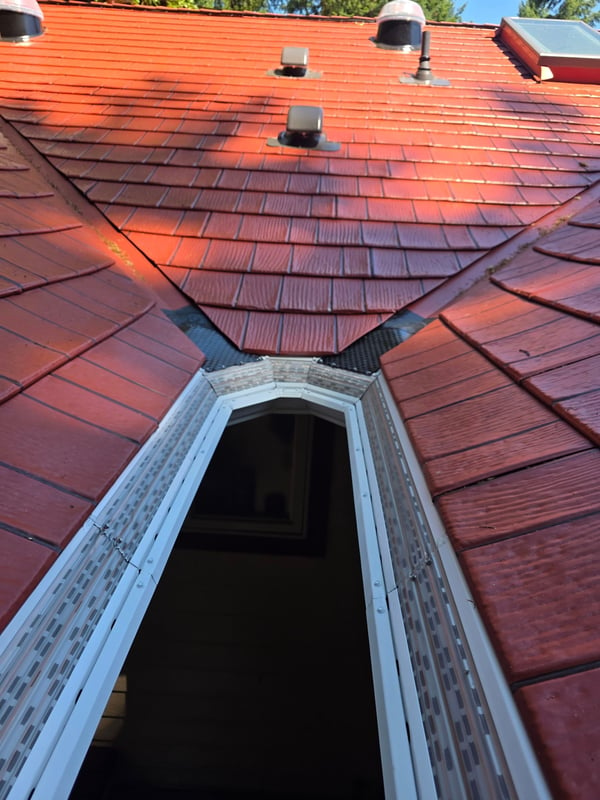
I've run water onto loose pieces of MasterShield from a faucet at all kinds of angles, and it still pulled the water through. You can see the MasterShield faucet demo in our gutter guard video. I've even held it upside down and shot water up at it, and the water still came through.
Does Leaf Relief work on steep roofs?
Yes, it accepts the water, but on a very steep or metal roof, heavy rain can splash off its solid surface and up under the roof edge. When water is really moving, it splatters where it hits that shelf, and some of it goes up underneath.
That's fine if the roof edge was designed for it, but that isn’t always the case. If it wasn't, you get wet plywood, rafter tails and fascia. But that type of damage isn’t covered under a Leaf Relief warranty, because the guarantee is that the gutter won’t plug.
Our post on whether gutters need to be installed on a fascia board explains why that wood matters.
Why does water shoot over flat mesh gutter guards?
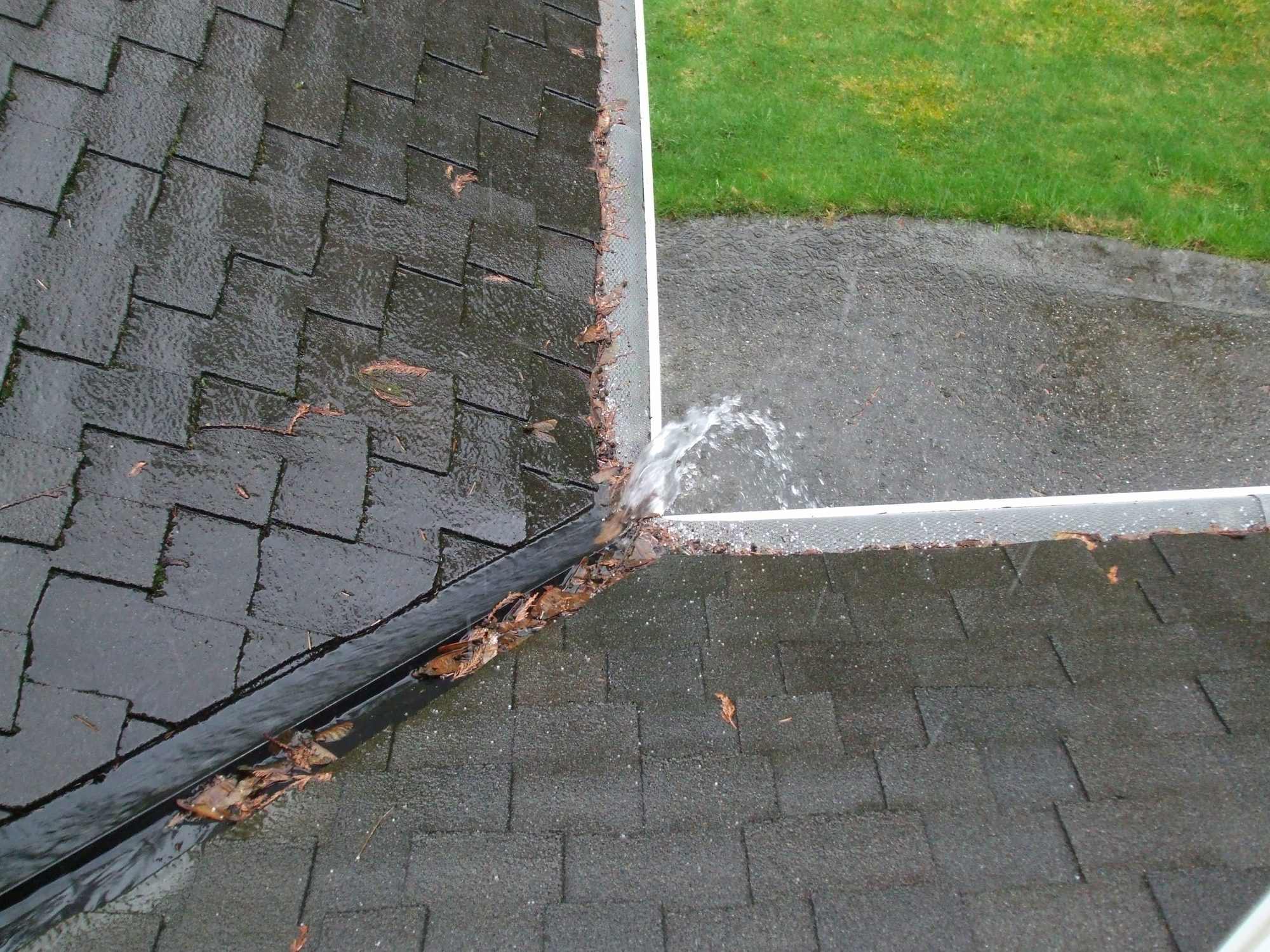
A flat mesh guard sits below the shingle edge, so water drops onto it and loses its forward push, and in heavy rain fast water off a steep roof runs across the top and over the front instead of going through.
That's how MasterShield's HydroVortex page describes it: a standard micro-mesh guard "is installed flat, below shingle level."
This is about overshoot, not overflow. Overflow is the clog problem, when a full gutter spills over. Overshoot is water missing the gutter completely, and that's the steep-roof problem.
MasterShield is micro-mesh too, so this isn't mesh against no mesh. The difference is a gutter guard that sits flat against a gutter guard that is pitched with the roof. Not every mesh guard overshoots. But if your gutters weren't overshooting before, and they started right after a flat mesh guard like LeafFilter went on, I think you know what the problem is.
For a head-to-head of two well-known mesh guards, see LeafFilter vs. MasterShield. For the other ways guards fall short here, read why most gutter guards fail in Seattle.
Do I really need gutter guards on a steep roof?
Often you need less help with debris on a steep roof, but you still need your gutters to catch the water, so the guard's job is to take the water and let debris fly by. If water is shooting off, a lot of the debris is probably sliding off too.
Steeper roofs tend to last longer, in my experience, because water drains faster and debris doesn't sit on them.
We cover the bigger question for any roof: Do I really need gutter guards on my Seattle roof?
How can I tell from the ground if water is overshooting my gutters?
Watch your gutters in a hard rain. If water is coming over the front instead of going in, the system isn't working, because the whole point of a gutter is to catch that water.
If you're asking this, you're probably not going up there to look, and that's fair. Here's what to watch for from the ground.
- Water sheeting over the front lip in heavy rain
- A waterfall at an inside corner below a valley
- A trench or splash marks in the bed under one spot
- Staining on the fascia or siding
How do I stop water from overshooting my gutters on a steep roof?
It depends on what you see: overshooting in a spot or two is a small fix, while clogging plus overflowing calls for a better guard. Use this as a starting point, then read the sections below for the details.
| What you see | Where to start |
|---|---|
| Water overshoots in one or two spots, often under a valley | A diverter at that corner |
| Gutters hang too low, or a big metal valley shoots water past the gutter | Resetting the gutter |
| Gutters clog and overflow | A guard that keeps debris out and still takes the water |
| Water started overshooting after a flat mesh guard went on | The guard itself (see the flat mesh section above) |
Is a gutter diverter enough to fix overshooting?
Often, yes. If water overshoots in only a couple of spots, building up the gutter's front wall at that corner is the cheapest fix.
Just know what it does and doesn't do. A diverter fixes where the water lands, but it does nothing for clogging. In fact, it can actually become a problem area where debris collects.
When should I get MasterShield instead of a diverter?
When you have clogging and overflowing, not just overshooting. Those are two different problems, and a diverter only solves one of them.
RoofSmart is MasterShield's exclusive certified installer, so take my opinion with that in mind. Valleys are a common trouble spot, and our MasterShield valley controllers are custom, fabricated in the field. Here's more on why gutter guards clog at the valley.
Can gutters that hang too low cause overshooting?
Yes. A gutter set too low, or a long metal valley aimed past it, can miss the water even with no guard at all.
When we retrofit MasterShield, that all gets addressed as part of the install, but you don't need MasterShield to fix it. If you suspect the layout is the issue, see is the layout of my roof causing my gutters to flood.
What are the downsides of gutter guards on a steep roof?
Every fix for steep-roof overshoot has a trade-off, and the roof itself is harder and riskier to work on.
- Leaf Relief takes the water, but splash can get up under the roof edge on a very steep or metal roof (see the Leaf Relief section above).
- MasterShield is more than you need for a spot or two of overshooting (see the diverter section above).
- A diverter only changes where the water lands (see the MasterShield vs diverter section above).
- Steep roofs are harder and riskier to work on, because everything wants to slide off, including the person installing or cleaning. That makes the install and any upkeep more involved.
Which gutter guard is right for my steep Seattle roof?
If water only overshoots in a spot or two, start with a diverter; if you have clogging and overflowing, choose a guard that takes the water, such as MasterShield or Leaf Relief. Either way, judge any guard by whether it catches the water, not just whether it stays unclogged.
On a steep roof, Leaf Relief and MasterShield are the two we recommend, and a diverter is the low-cost option when the problem is small. You can see the other styles in the best gutter guards for Seattle homes and learn about our gutters and gutter guards service.
Your next step: a free SmartMatch Needs Analysis, where one of our meticulous roofing nerds looks at your roof and gutters with you. Call (206) 487-4877, Mon to Fri, 8AM to 5PM.
Read next: MasterShield Gutter Guard Review: Does It Work for Seattle Homes?
Want to see how we'd look at your roof?
Start with a SmartMatch™ Needs Analysis, or call (206) 487-4877.
Frequently Asked Questions
1. Can a gutter guard keep my gutters from clogging but still let water spill over?
Yes. A guard can keep the gutter clean and still let fast water spill over the front, especially on a steep roof. The guard is doing what its warranty promises, but the water isn't getting in. Read more on why most gutter guards fail in Seattle.
2. Do steep roofs last longer than low-slope roofs?
In my experience, they tend to, because water drains faster and debris doesn't sit on them. The trade-off is that they're harder to work on. See what roof pitch is and why it matters.
3. What roof pitch counts as a steep roof?
NRCA, the national roofing contractors' association, generally treats roofs steeper than 3:12 (14 degrees) as steep-slope roofs. NRCA also recommends shingles only on slopes of 4:12 (18 degrees) or more, but that's its shingle minimum, not its definition of steep. Both lines are in NRCA's most frequently asked technical questions from April 2013. Our post on what roof pitch is and why it matters explains how pitch is measured.
4. Can gutter guard splashing rot my fascia or rafter tails?
It can, if splashing water gets up under a roof edge that wasn't built for it. The gutter stays clear, but the wood behind it gets wet storm after storm. Our post on whether gutters need to be installed on a fascia board covers how that edge goes together.
5. Can a gutter guard block my roof's drip edge?
Some can. I've seen a guard where the way it meets the gutter leaves no room for drip edge flashing. On a shingle roof that matters, because the residential code (IRC R905.2.8.5, which Washington adopts with no state amendment) requires a drip edge at the eaves and rake edges of shingle roofs; you can read it in the 2021 Seattle Residential Code, chapter 9. If you're worried about your roof coverage, see can gutter guards void your roof warranty.
6. How long do gutter guards last?
Gutter guards can last 20 to 30+ years. MasterShield carries a lifetime warranty. How long yours lasts also depends on how well it was installed.
7. What warranty does MasterShield come with?
MasterShield gives a "lifetime warranty," per its warranty page, and calls it a "no clog warranty." Like the other warranties we checked, it's about keeping the gutter clear, and that page says the gutters, hangers and sealants themselves aren't covered. For how guard warranties compare, see what gutter guard warranties really cover.
8. Why do gutter guards clog where two roof slopes meet?
Valleys send a lot of water and debris to one spot, so that's where guards get overwhelmed. MasterShield valley controllers are custom, fabricated in the field to handle it. See why gutter guards clog at the valley.
9. Can I test a gutter guard with a garden hose?
Yes, but test the guard that's actually on your roof, not a loose piece on the ground, because that's the only way to see how your own install handles the water. What I can tell you is that I've tested loose pieces of MasterShield with a faucet at different angles, and even upside down, and it still pulled the water through. If you try it, be careful on the ladder: set it on firm, level ground, and don't step off it onto a steep roof.
10. Will a gutter guard work on a really steep roof in Seattle?
It depends on the guard. MasterShield says its guards work on roof pitches from 22.5 to 75 degrees, and since we're MasterShield's exclusive certified installer, that's the one I know best. Not sure how steep yours is? Book your free SmartMatch Needs Analysis and we'll look at it with you.
