

.jpg?width=800&height=450&name=Seattle%20Rooftop%20Deck%20Project%20(9).jpg)
TL;DR: Summary
Wood tiles and long planks both work for rooftop decks, but tiles perform better in Seattle’s wet climate due to superior stability and airflow.
Wood tiles resist warping, are easier to install and repair, and dry more evenly, especially when installed on pedestals that allow airflow underneath.
Long planks are more affordable and offer a classic look, but they’re more prone to warping, cupping, and moisture damage due to uneven drying. And they’re hard to get up those stairs!
The key takeaway: while tiles cost 25–40% more upfront, they’re typically the better long-term investment for durability and performance in Seattle’s damp environment.
Are you worried that the rooftop deck material you choose could warp, rot, or fail quickly in Seattle’s constant rain and damp weather? Do you feel stuck choosing between wood tiles and long planks because you can’t tell which one will actually hold up better over time?
While both wood tiles and long planks can look beautiful, they perform very differently when exposed to Seattle’s climate. Choosing the wrong option can lead to warping, costly repairs, and ongoing maintenance headaches much sooner than expected.
At RoofSmart, we replace hundreds of roofs every year, including rooftop decks. We help each customer find the perfect roof material for them by giving recommendations based on their budget and preferences. We also openly discussed the pros and cons of each one of their roofing options.
In this article, we’ll compare wood tiles and long planks side-by-side, break down how each performs in Seattle’s rainy environment, and explain which option offers the best balance of durability, appearance, maintenance, and long-term value for your rooftop deck.
Wood Tile vs Long Plank Decking (Seattle Rooftop Deck Material Comparison)
|
Category |
Wood Tiles |
Long Wood Planks |
Why It Matters |
|
Stability (ability to maintain their shape after absorbing moisture) |
⭐⭐⭐⭐⭐ Very high |
⭐⭐ Low–Moderate |
Tiles are less likely to warp due to shorter length |
|
Moisture Performance |
Excellent airflow underneath |
Limited airflow |
Faster drying prevents rot and damage |
|
Installation Speed |
Faster (modular system) |
Slower (piece-by-piece) |
Impacts labor cost and timeline |
|
Repairability |
Easy (replace one tile) |
Difficult (affects surrounding boards) |
Saves time and money long-term |
|
Cost (Material) |
Higher ($18–$26/sq ft) |
Lower ($12–$18/sq ft) |
Budget vs performance tradeoff |
|
Aesthetic |
Modern, high-end look |
Classic wood deck look |
Design preference |
|
Long-Term Durability |
Higher |
Lower |
Tiles perform better in Seattle’s climate |
What are the pros and cons of using wood tile on my Seattle rooftop deck?
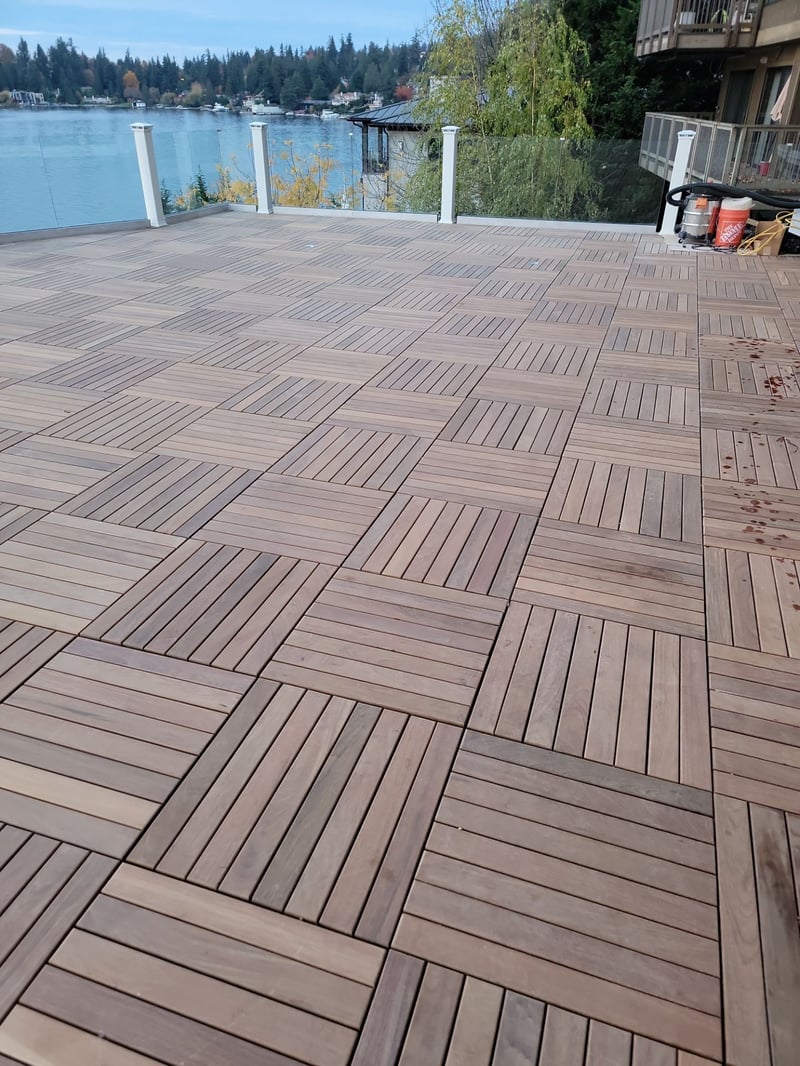
Wood tiles are a popular option for Seattle homeowners who want an elevated, luxurious feel on their rooftop deck. You cannot go wrong with these.
Pros
- Superior stability
- Less prone to warping
- Elegant, luxurious feel
- Easier to install
- Easy to pop out a tile for repair
- Elevated on pedestals for better airflow underneath. That allows drying to happen at least some of the time.
Cons
- More expensive
- Require maintenance to maintain color, if you choose a tile that needs a wood stain (not all do)
- Cheap pedestals can make the tiles feel bouncy
What are the pros and cons of using long wood planks on my Seattle rooftop deck?

Seattle homeowners choose long wooden planks for a classic rooftop deck feel. This option looks great and helps to decrease your material costs a bit.
Pros
- More affordable
- Classic look
Cons
- Evaporation beneath planks will mess up a long board
- Prone to warping when wet
- More time-consuming to install
- Repairs might disturb the surrounding boards
Can Seattle’s damp, rainy weather damage wood tiles and planks on your rooftop deck?
It’s no secret that wooden materials used on homes in the Seattle area are at a higher risk of rot and damage in this area’s damp, rainy environment. Water can soak into both wood tiles and long planks, but long planks are far more likely to warp as they dry.
In terms of warping resistance, superior airflow, and ease of installation and repairs, wood tiles are a better choice for enduring Seattle’s rain and constant dampness. Although they are more expensive upfront, their durability can help you save money in the long run.
There are two main factors that affect the dimensional stability: size and type of wood.
- Size: A shorter piece of wood (like the length used in a piece of tile) is more likely to dry uniformly. However, longer boards are more prone to warping, twisting, or cupping. Wood has a "memory" of its original shape in the tree. Long boards are more likely to contain knots, heartwood/sapwood transitions, or grain deviations that cause "bowing" (warping along the flat side) or "springing" (warping along the edge). It’s much easier to find a stable two-foot piece than a perfectly stable 20-foot piece.
- Type of wood: Different species of wood have different amounts of porosity, so the type of wood you choose might be more or less likely to absorb a lot of water. Ipe is the best option because it is the most dimensionally stable, but it can still get messed up if you do long, thin planks. Ipe is special because it’s denser and has less space for water to soak in. It's worse if you do any other type of wood because they’re more prone to cupping and splitting.
Stability of Ipe vs. Other Rooftop Deck Material Types
|
Species/Material |
Density (Janka Hardness) |
Shrinkage Rate (Volumetric) |
Primary Stability Risk |
|
IPE |
3,680 lbf |
~12% |
Surface checking (fine cracks) |
|
Western Red Cedar |
350 lbf |
~6.7% |
Extreme softness/scuffing |
|
PT Pine (SYP) |
690 lbf |
~12.3% |
Severe warping/cupping |
|
Composite (WPC) |
N/A |
High (Thermal) |
Linear expansion/sagging |
- IPE vs. Cedar: Cedar is typically a great material, and we recommend it for siding, trim, and even wood shakes. However, cedar is a softer wood than IPE, which gives IPE a structural advantage.
- IPE vs. Pine: Pine wood is cheap, but it’s also a mediocre material (at best). I don’t even recommend this for trim or siding because it absorbs moisture easily and is very prone to warping, bowing, and splitting. IPE is pretty much the opposite of pine.
- IPE vs. Composite Decking: Composite decking is a popular alternative to wood materials. However, what most people don’t realize is that composite materials can expand in the heat, meaning that your deck might rip out fasteners in the summer. IPE is much more stable in heat.
Most of the time, tiles are installed on a pedestal system that props the tiles up a few inches and allows air to flow underneath them, which helps the tiles to dry out faster. Long planks usually do not have anything underneath, so airflow is limited.
One of the big challenges with long planks that are not elevated is that the sun is hitting the top, but nothing is hitting the bottom. So the top dries, but the bottom is wet. And then it shrinks, and the bottom stays wet, which causes cupping.
What is the cost difference between tile and long planks?
Typically, tiles cost 25% to 40% more than the actual planks. But keep in mind that this is the material only price, so labor costs might change your total job cost. Tile does cost more, but it does go in faster, which helps to cut down on labor costs.
Price Per Square Foot (Material Only):
- Ipe Planks: $12-$18
- Ipe Tile: $18-$26
Other factors you should consider when considering the cost of your rooftop deck are:
- Building from scratch vs. replacing your existing rooftop deck material
- Potential need to replace rotting wood
- How accessible your rooftop deck is
- Do you need to install or replace your railing?
- Is your rooftop deck already set up properly? (i.e., waterproofed and sloped for drainage)
How much does it cost to install a rooftop deck in Seattle?
As you’ve seen, choosing between wood tiles and long planks isn’t just about appearance. It directly affects your rooftop deck’s durability, maintenance needs, and long-term performance in Seattle’s wet climate.
While wood tiles typically cost more upfront, they often provide better airflow, improved stability, and easier repairs, which can help prevent expensive issues like warping and rot later on. Long planks may save money initially, but they can require more maintenance and repairs over time.
Of course, decking material is only one part of the total project cost. The size of your rooftop deck, waterproofing system, railing installation, accessibility, and any hidden rot repairs can all significantly impact your final price.
Read our article “How Much Does It Cost to Install a Rooftop Deck in Seattle?” to learn the real costs of rooftop deck installation in the Seattle area so you can better understand what to budget for and which upgrades are worth the investment.
Frequently Asked Questions About Wood Tile vs. Long Planks on a Rooftop Deck
1. Are wood tiles better than long planks for rooftop decks in Seattle?
In most cases, yes.
Wood tiles perform better because they:
- Allow airflow underneath
- Dry more evenly
- Resist warping
This makes them better suited for Seattle’s damp, rainy climate.
2. Why do long wood planks warp on rooftop decks?
Long planks dry unevenly.
- The top dries from sun exposure
- The bottom stays wet
This uneven drying causes boards to cup, twist, or bow over time.
3. What is the best wood type for rooftop decks?
Ipe is one of the best options.
It is:
- Extremely dense
- Less porous (absorbs less water)
- More dimensionally stable
Other woods like cedar or pine are more prone to damage and warping.
4. Are wood tiles more expensive than planks?
Yes, typically by 25% to 40% in material cost.
However:
- Faster installation can reduce labor costs
- Better durability can lower long-term repair costs
So the total cost difference may be smaller than it seems.
5. Does airflow really matter for rooftop deck materials?
Yes, it’s critical.
Proper airflow:
- Helps materials dry faster
- Reduces moisture buildup
- Prevents rot and warping
This is one of the biggest advantages of wood tiles installed on pedestal systems.
Topics:
