

.jpg?width=800&height=450&name=PVC%20roof%20(with%20metal).jpg)
Are you worried your flat roof might not hold up in Seattle’s rainy, moisture-heavy climate? Have you been told PVC is the best flat roofing option, but now you're seeing bubbling, cracking, or even leaks?
After installing and replacing hundreds of PVC roofs, we at RoofSmart have seen time and time again how small mistakes during installation (like missing sealant or poor welds) turn into big, expensive problems like leaks, trapped moisture, or even structural rot.
In this article, we’ll break down the most common reasons PVC roofs fail in the Seattle area, what those failure points look like, and how to make sure your roof is protected from day one.
Are PVC roofs supposed to be vented?
All roofs need some sort of insulation. However, it's rare that a PVC roof should be vented traditionally. PVC roofs are tricky because they're totally impermeable, so you don't get any vapor diffusion. Any moisture that comes up through that structure is trapped.
A lot of people are focused on what the best kind of roofing material is best for their flat roof. However, it doesn’t matter how great it is if your roof is not properly ventilated underneath because that will lead to condensation issues.
You need what is called a “warm roof” assembly, but not everybody's budget allows for that. This style of ventilation layers insulation and roofing material together and is expensive to add to your roof.
If you can't do a warm roof and you need to try to vent it, it's going to be difficult. You have to make sure you have unobstructed air pathways, just like in a normal sloped attic.
A lot of times, you're going to need to add mechanical ventilation because regular static pressure is not going to be enough to generate enough of a stack effect to get it to flow.
You need to have more than three vertical feet of rise to get it to flow at all. And a lot of times with a flat roof, you don't even have that. You might need to add a powered vent, and that'll work as long as there's enough intake.
What are the common issues with PVC roofs?
Although PVC is a good flat roofing material, it still has some potential problems. Here are some common failure points in PVC:
- Cold Welds: These are seams that got hot enough to stick but didn't fully bond. It looks like a regular weld because it still sticks down, so they’re very difficult to identify. This problem is more common with hand welding (as opposed to using a robot) because it’s more difficult to maintain the right temperature.
- Effect: The weld can pop open later due to thermal contraction, creating a hard-to-find leak.
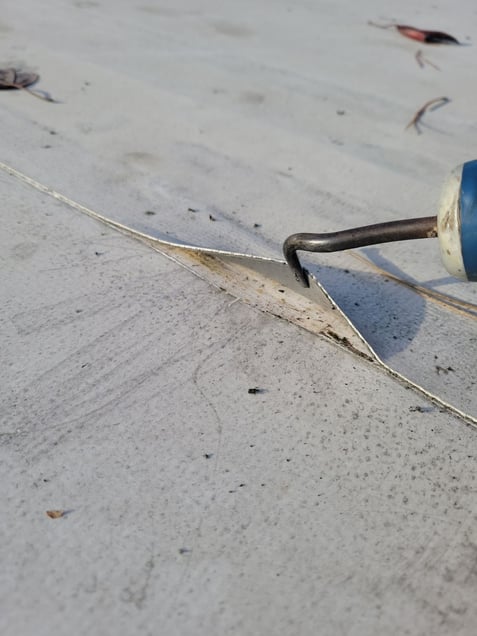
This is what a cold weld looks like. You shouldn’t be able to lift the edge up like that, but it does here because it wasn’t properly welded down.
- Freeze-Thaw Damage: This happens when moisture wicks into cut edges of reinforced membranes. Your roofer is supposed to apply sealant over the edges that they cut to protect your roof from this issue. Failure to apply cut-edge sealant also voids the warranty. The sealant will fade over time, so even if you did apply it, it needs to be replaced.
- Effect: Water getts into the PVC and expands when it freezes, causing membrane ruptures, crazing, and cracking.
- Solution: Use non-wicking membranes like Duro-Last, which have polypropylene-dipped fibers and require no sealant.
- Thermal Shrinkage and Expansion: PVC shrinks in cold weather, but that isn’t really an issue. However, on a hot day, it can expand. You can get around that by fully adhering the membrane, but that glue is really expensive, and it's more labor-intensive and so most people don't do it.
- Effect: Thermal expansion causes wrinkles, which can reduce wind uplift resistance. That's still not a big deal as long as it's properly installed. If it's got enough screw plates, it's not going anywhere. But if it’s not secured well enough, then the membrane can blow off the roof.
Here’s an example of the edge of the roof with a big wrinkle blowing in the wind:
As your PVC roof gets older, the roof membrane will weaken and become less effective. Here are some of the signs that your PVC roof is getting old:
- Chalking: This looks like a white, powdery residue on the roof. It means that UV damage is breaking down plasticizers in the PVC. Basically, it means that your roof is deteriorating. This process can be accelerated by standing water or reflected sunlight.
- Effect: Indicates the membrane is losing flexibility and nearing failure.
- Joint Failure: In most flat roofs, including PVC, unreinforced joints (e.g., scuppers) fail first. This can be due to poor installation or just because these joints are usually the weakest points on the roof.
- Effect: This is a difficult issue to repair because the old membrane loses flexibility and won't weld to new material. Lack of flexibility in the material is a sign that the roof is getting old.
How do I make sure that my roofer installs my PVC roof correctly?
While you're looking for roofers, you want to make sure to look for someone who has a lot of experience installing PVC roofs and insulating flat roofs.
Basically, for anybody that you're interviewing about a PVC roof, if they don't bring up condensation as a concern, you probably shouldn't hire them.
This is a huge issue in the Seattle area. If your roof isn’t protected against condensation, then you’re going to have to pay thousands of dollars to replace the rotten wood and redo the roof.
PVC or Torchdown: What’s the best flat roofing material for your Seattle home?
Now that you understand why PVC roofs fail, and how ventilation, cold welds, and installation shortcuts can all lead to early roof problems, you might be wondering whether PVC is even the right choice for your Seattle flat roof in the first place.
The truth is: PVC isn't your only option. Another common flat roofing material in the Seattle area is torchdown roofing. But how do these two materials really compare in terms of durability, water resistance, cost, and long-term performance?
We think it’s important to know the full picture before you decide which roof material you want, so don’t discount PVC until you’ve heard its pros and compared it to options.
Read our article “Torchdown vs. Single-Ply PVC: Which One Is Best for Your Roof?” to help you choose the right material for your home, budget, and climate.
Topics:
