

TL;DR: Summary
Comparing roofing bids can be overwhelming for those without construction experience, but Artificial Intelligence can act as a "technical assistant" to level the playing field. By feeding detailed proposals into a tool like ChatGPT, Grok or Claude, homeowners can quickly spot missing line items, check if the scope meets manufacturer warranty requirements, and identify why prices vary so drastically.
However, AI is only as good as the data it receives and the precision of your prompt; homeowners should still verify all findings and watch for red flags like vague lump-sum quotes or missing ventilation details.
Do you feel overwhelmed trying to compare roofing proposals, even though you’re not a contractor yourself? Are you afraid you’ll get stuck with hidden fees, missing steps, or a proposal that sounds impressive but cuts corners where it matters most?
If these thoughts are bouncing around in your head, you’re not alone, and you’re asking the right questions.
At RoofSmart, we replace hundreds of roofs every year. Before each roof project, we sit down with each customer to explain the bid line by line so that our customers feel confident about what they are paying for.
We believe that Seattle homeowners like you deserve to feel confident, not confused, when it comes to major roof work.
This article will walk you through how to evaluate roof proposals fairly, including how AI tools can help you catch mistakes, compare the scope of work, and understand price differences, even if you have zero roofing experience.
| Aspect to Compare | Good / Trustworthy Proposal | Red Flag / Warning Sign | Why It Matters |
|---|---|---|---|
| Contractor Evaluation | Clear services, relevant photos, verifiable license/insurance, balanced reviews | No gallery, vague services, unverified license, only glowing reviews | Ensures the company can actually do quality work |
| Scope of Work | Detailed line items with labor descriptions | Vague lump-sum or “roof replacement” only | Prevents missing work or surprise change orders |
| Materials | Specific brands, quantities, and grades listed | Generic “standard shingles” without details | Allows true apples-to-apples comparison |
| Warranties | References manufacturer requirements + workmanship | No mention or vague “standard warranty” | Protects you long-term |
| Pricing | Itemized with explanations for differences | Huge unexplained price gaps or suspiciously low bid | Reveals hidden costs or corner-cutting |
| Change Orders / Extras | Clear warnings about potential uncovered damage | No mention or pressure to sign quickly | Prepares you for real-world surprises |
Do you trust your roofing contractor to write a quality proposal?
Before you take a look at the proposals you’re getting from your roofing contractor options, it’s important to take a step back and consider how much you trust them with your roof.
Are you simply gathering a bunch of proposals to compare prices, or are you evaluating each roofer’s trustworthiness and experience before considering their proposal?
Of course, you want to get a reasonably priced roof. That’s completely valid! But we recommend that you take the time to evaluate your contractors to make sure that you think they are knowledgeable and reliable enough to work on your roof.
Here are some quick tips for evaluating your roofer:
- Check the services they offer and their photo gallery: When you go to any roofer’s website, they should list out the services they offer. This will tell you if they can help you with your roofing needs. Some roofing companies even offer carpentry, siding, or other services beyond roofing. You should also check their photo gallery to see what kind of roofing jobs they’ve done. This will help establish their skills and expertise and show you if that roofer can help with the kind of roof work they need.
- Verify your contractor is licensed and insured: Go to the WA State Department of Labor and Industries’ Verify tool. This shows you if your contractor
- Is licensed
- How long they have been in business
- If they have insurance
- If anyone has filed complaints against them
- If they have any workplace safety violations
- How many people work at their company (which can help you estimate how many roofing crews work there)
This site has a lot of useful information that shows you how a company is operating. Here’s an example of what it looks like when you search for RoofSmart:
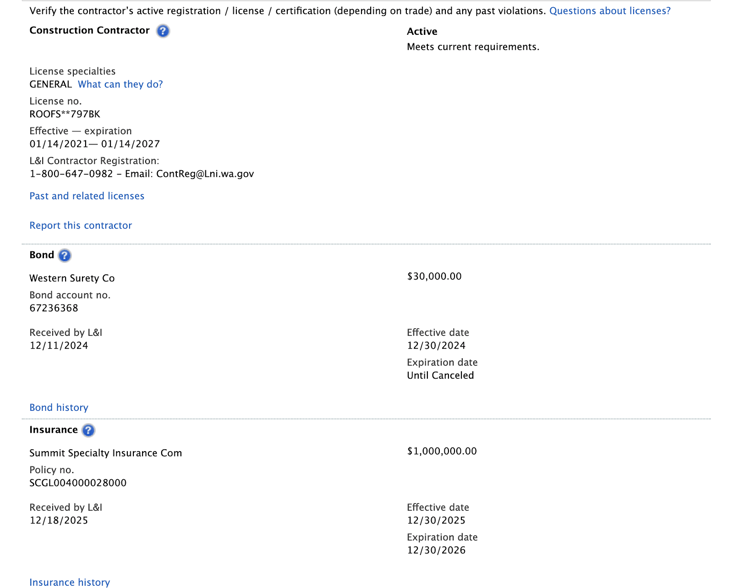
This shows you that RoofSmart is operating legally because the business license, bond, and insurance are all up to date.
- Read a lot of reviews: This one is a classic for a reason. Positive AND negative reviews can tell you a lot about a company. Remember to also look at the rating and total number of reviews, as well as checking multiple different sites with reviews to get a lot of different perspectives.
If you want to speed up this process, you can ask AI to give you an overview of the reviews, including both positive and negative ones.
What are the common things to look for in every proposal?
When comparing proposals, you want to make sure that they have the same type of information. Proposals contained detailed information about pricing, which makes them difficult to compare to quotes or estimates because those are more vague.
Here’s what you can expect to see in a proposal:
- Scope of work: All of the steps that your roofer will need to take to do all of the work your roof needs should be outlined in the proposal. They will list out how much the labor will cost with the descriptions.
- Materials: Of course, you’ll also see a list of all the materials they need. The proposal should say how much of each item is needed and list a price for each item.
- Potential for change orders: There might be some potential additional costs that you’ll be warned about. There won’t be a price for this because there’s no way to know what it will cost. But your roofer might acknowledge that damage or problems might be uncovered during the roofing process (based on the condition of your roof) and advise you to set aside some extra money just in case.
How can AI help me compare roof proposals?
Now it’s time to compare your proposals. This can take quite a while and quickly become overwhelming. An easy way to compare proposals is to have AI help you.
AI is still new and can sometimes make up information, so make sure that you tell it not to lie or make stuff up. You should also give it specific instructions to keep it on track. For example, here are a few different questions you can ask AI to help you effectively compare proposals:
- Is my roofer doing enough to meet warranty requirements? What you want AI to do is to check the scope of work versus what the manufacturer's requirements are for installing materials. This is important because you might find that your roofer didn’t list all the steps necessary to meet the requirements for the manufacturer’s warranty.
You can ask AI to evaluate against manufacturer specifications and the local building code to ask what steps your roofer could be missing that would make a real negative or positive difference on your roof.
- Is all the roof work I asked for listed in the proposal, or is something missing? First, you must establish whether you told the contractor what you wanted or if you just had them come up with it all by themselves.
You can have AI take a look at what information is present versus what's maybe left out or just not included. This works best if you write out a list of everything that you expect to be done on your roof so that AI has a comparison point.
You can also ask your AI tool if every step is actually necessary or if that's just an extra thing. This is probably a good time to ask it to cite some sources just to make sure it is sharing truthful information. If you have any doubts about what roof work needs to be done, make sure you talk to your roofer about it.
- Can you compare the total prices on each proposal and explain why they are different? You can also have AI compare and contrast the prices to see why they are different. This is most useful when there are drastic differences in price.
You can ask AI this question: “Based on best available information, what is the reason for the price difference based on the scope of work?”
Sometimes there are hidden costs in roof proposals. This can include mandatory fees that the roofer has to pay to operate, or unexpected extra costs that might come up later.
Some companies cost more than others because they aren’t charging the right amount for stuff, or they are leaving steps out to save money. Some roofers might also choose not to pay those mandatory fees to cut down on costs.
Disclaimer: If you aren’t familiar with AI or don’t want to use it, then you can also ask yourself these questions and use them as a guide to do your own comparison.
What Red Flags Should I Look for When Comparing Roof Proposals?
Now that you know how to break down the details of a roofing proposal (and even use AI to help double-check things like scope, pricing, and code compliance), the next step is just as important: watching out for red flags during the comparison process.
After all, two proposals might look similar on paper, but one roofer may cut corners or rely heavily on caulking, while another follows every best practice (even if it's not the cheapest option). The experience, transparency, and reputation of the contractor matter just as much, if not more, than the proposal itself.
Ready to take your evaluation to the next level by learning about red flags? Read our article “Roof Proposal Red Flags: How to Compare Proposals From Different Roofing Replacement Contractors”.
Frequently Asked Questions About Comparing Roofing Proposals
Q: How do I compare roofing proposals fairly?
A: Make sure all proposals cover the same scope (tear-off, underlayment, flashing, ventilation, etc.). Compare line-item details for materials, labor, warranties, and potential change orders rather than just the bottom-line price.
Q: Can AI really help compare roofing estimates?
A: Yes -- AI can summarize reviews, check if scope meets warranty requirements, spot missing items, and explain price differences. Provide clear prompts and always verify the output with a professional.
Q: What red flags should I watch for in roofing proposals?
A: Vague descriptions, no itemized costs, big unexplained price differences, pressure to decide quickly, or proposals that minimize known issues like attic mold or ventilation problems.
Q: Should I choose the cheapest roofing proposal?
A: Not necessarily. A much lower bid often means omitted work, cheaper materials, or corner-cutting. Focus on value: complete scope, quality materials, strong warranties, and a trustworthy contractor.
Q: How important is the contractor’s license and insurance when comparing proposals?
A: Extremely important. Use WA L&I Verify to check licensing, insurance, complaints, and business history. An uninsured or unlicensed roofer can leave you liable for problems.
Q: What’s the best way to use AI when evaluating roofing proposals?
A: Feed AI the proposals (or key sections) and ask specific questions about completeness, warranty compliance, and price justification. Treat it as a smart assistant, not the final decision-maker.
Frequently Asked Questions
1. How do I give a roofing proposal to an AI for comparison?
You can copy and paste the text from a PDF or digital proposal into the AI chat window. For the best results, provide a clear prompt like: "Compare these two roofing proposals and tell me if either one is missing critical manufacturer installation steps or local building code requirements. Which one seems to be more thorough?"
2. Can AI tell me if a roofing quote is a "fair" price?
It can give you an educated estimate based on the data it has, but prices change and are (or should be) specific to your project. Ask the AI: "Based on recent data for the Seattle area, does the labor-to-material ratio in this bid seem standard for a high-performance architectural roof?"
3. Is AI reliable for checking manufacturer warranty compliance?
Yes, if you ask it to cross-reference the proposal's materials with that specific manufacturer’s installation guide (e.g., Owens Corning or GAF). It can highlight if a contractor is skipping necessary components like specific underlayments or starter shingles.
4. What is the biggest risk of using AI to evaluate a roof bid? "Hallucination." AI can sometimes confidently state a fact that is incorrect. Always treat AI as a secondary filter—use it to generate questions you can then ask the roofing contractor directly to verify their expertise.
5. Should I share my personal information with the AI?
No. Before pasting a proposal, delete your address, phone number, and name. The AI only needs the technical scope of work, material list, and pricing to give you an accurate analysis.
6. What are the common red flags AI might miss in a proposal?
AI is great with text but can miss "vibes." You should still watch for contractors who minimize technical problems like attic mold. See our guide on how to tell if an attic company is trying to upsell you or if your mold is bad.
7. How do I know if the roofer behind the proposal is actually qualified?
A proposal is just paper. You need to verify the people doing the work. Check our checklist on who will be working on my roof and how are they qualified.
8. Why do prices vary so much between two similar-looking proposals?
Often, the difference is in the "unseen" details like the weight of the shingle or the quality of the flashing. You can compare the cost of 30-year vs. 50-year shingles in Seattle to see how material tiers impact your bottom line.
9. Can I use AI to help me choose between roofers with similar ratings?
Yes, by feeding the AI the text of their reviews to find patterns in customer complaints or praise. This helps you decide between Seattle roofing companies that both have 5-star ratings.
10. What should I ask my estimator after the AI gives me its analysis?
Use the AI's findings to ask pointed, technical questions. If you aren't sure what to prioritize, read our guide on what to know about roofing before meeting with a roofer.
Topics:
