

TL;DR: Cedar Shake Roof - Repair or Replace in Seattle?
Cedar shake roofs look beautiful but are high-maintenance in the rainy Pacific Northwest. Minor isolated damage (a few broken shakes, small leaks, or moss patches) can often be repaired to add 10+ years of life. However, if you see widespread moss/rot, multiple leaks, excessive splitting/curling, or poor flashing across the roof, it’s usually more cost-effective to replace.
Quick Decision Guide:
- Repair if problems are isolated and the rest of the roof is sound.
- Replace if damage covers large areas or repairs would only be temporary band-aids.
Maintenance every 5 years (moss treatment, cleaning, spot repairs) can extend life to 40–50 years, but repairs become expensive over time. Always get a close-up professional inspection: roofs often look better from the ground than they really are.
Key takeaway: Don’t wait for interior leaks. Use our free Cedar Shake Roof Checklist or schedule a RoofSmart inspection for honest advice.
Is your cedar shake roof starting to look worn, mossy, or uneven, and you’re not sure if it needs a simple repair or a full replacement? Are you worried about pouring thousands of dollars into maintenance, only to find out you should have replaced it instead?
You’re not alone. Cedar shake roofs are beautiful, but they’re also expensive and high-maintenance. Minor problems on your wood shake roof can be resolved with a repair, but if you have leaks or damage all over, then it’s probably time for a replacement.
We at RoofSmart have been called out to perform maintenance on houses all over the Greater Seattle area. We’ve seen all kinds of damage and have helped guide our customers through the process of deciding if a repair or replacement is best.
In this article, we’ll walk through the most common cedar shake roof problems we see across the Greater Seattle area, and give clear guidelines to help you decide when a repair makes sense or when replacement is the smarter long-term investment.
Why Cedar Shake Roofs Fail Faster in Seattle’s Climate
Cedar shake roofs are pretty expensive to install and maintain, so not a lot of people choose to install this type of roofing material. They can last around 50 years, but that doesn’t mean they won’t have any problems before that.
Here are the most common problems that we see on cedar shake roofs in the Seattle area:
- Rot & Leaks:
- Debris in keyways (gaps between shakes), like moss, leaves, and pine needles, acts as a sponge. They soak up water on the roof and keep the wood around them wet. If the shake pieces don’t dry out properly, they can start to rot.
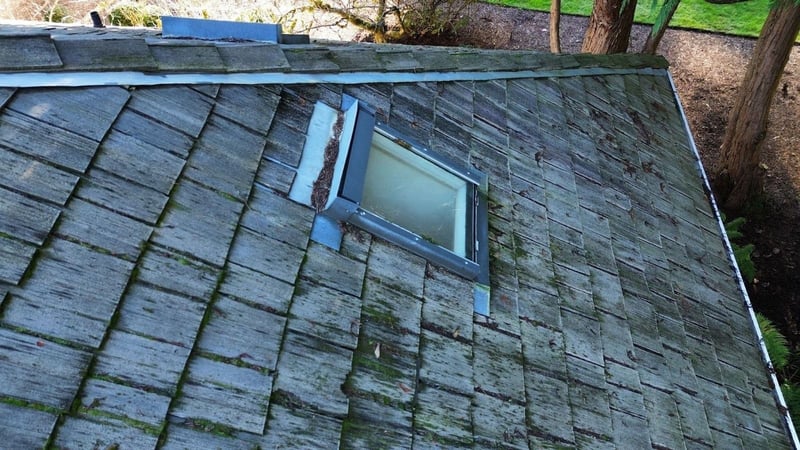
This is a fairly old roof that has a lot of moss growing in the keyways all over the roof. This is contributing to the rot and overall deterioration of the roof.
-
- Pressure washing thins out shakes. Each time you pressure wash them, you take a small layer off the top, thinning them out and creating small holes visible in the attic. This will definitely lead to leaks. Pressure washing can also take off chunks of the shake or even cause it to split.
Here’s an example of a hole in a cedar shake roof:
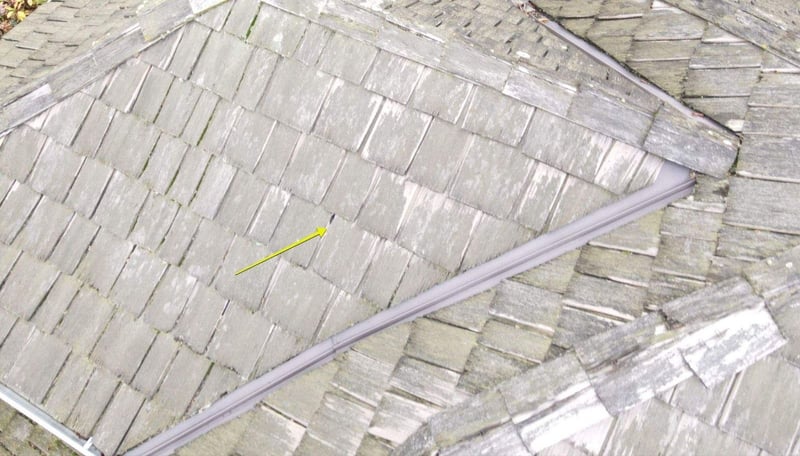
Holes in the roof can also be caused by falling branches.
Common Failure Areas:
-
- Hip and Ridge Caps: These often fail first. They are made of two pieces of wood stapled together. As a result, there is a small gap. Your roofer is supposed to alternate the position of each gap so that it doesn’t run down the hip or ridge in a straight line. This helps to prevent water from flowing through the gap and causing a leak.
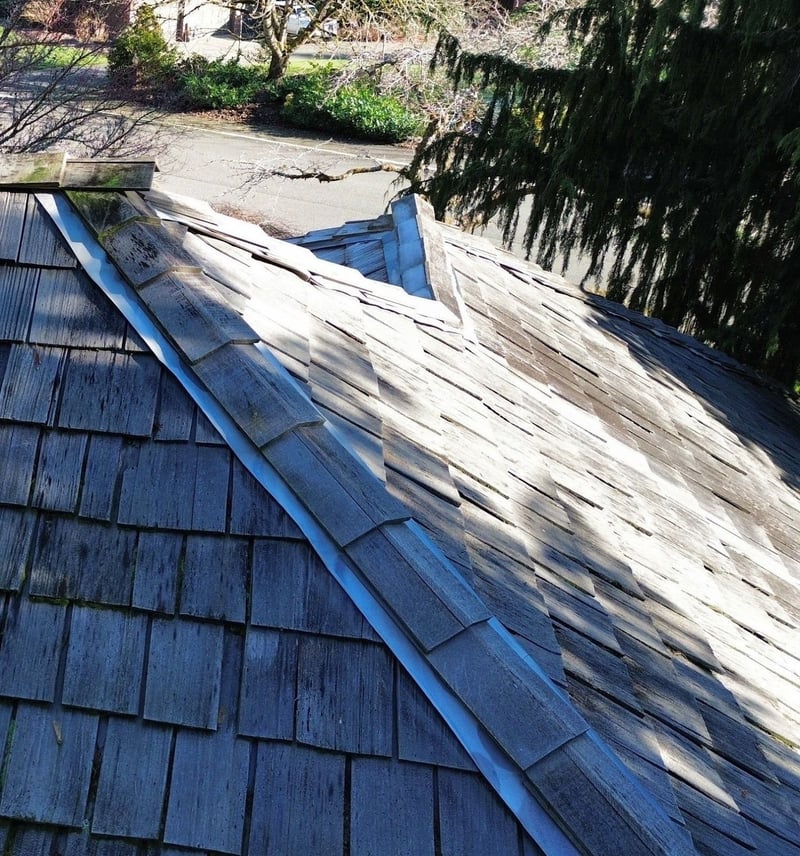
As you can see in this picture, some of the gaps line up, while others do not. These have been almost certainly replaced because they look a little bit newer than the rest of the roof, and they usually don’t last as long as the shakes used on the actual roof.
-
- Pipe Flashings: Poor quality or poorly installed pipe flashings can lead to leaks in your shake roof. This is a problem that can happen on any roof.
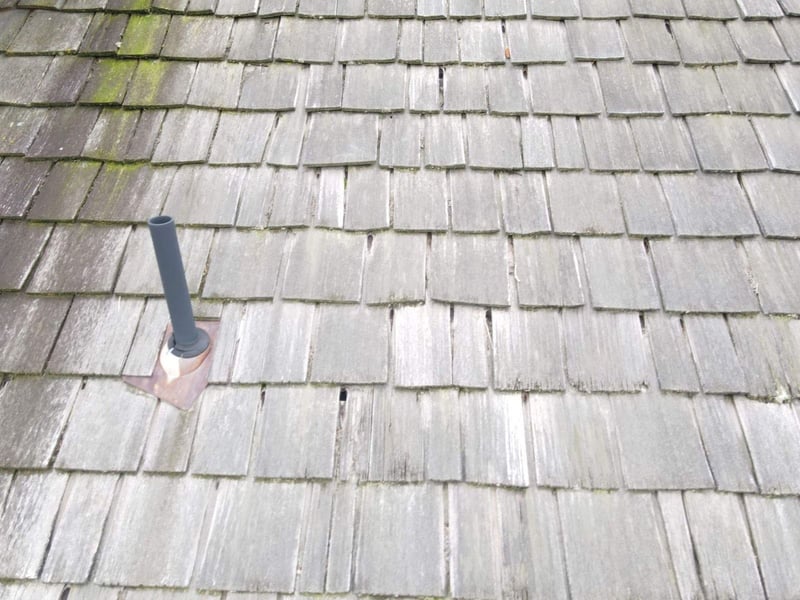
This pipe flashing is crooked and falling off, indicating that there was some sort of issue. It’s also old and rusty, which can indicate that it’s leaking.
-
- Splitting and Breaking Shakes: As the cedar shake gets old, it will start to split and break. In this image, you can see several spots where a small piece of the shake fell out because it split off:
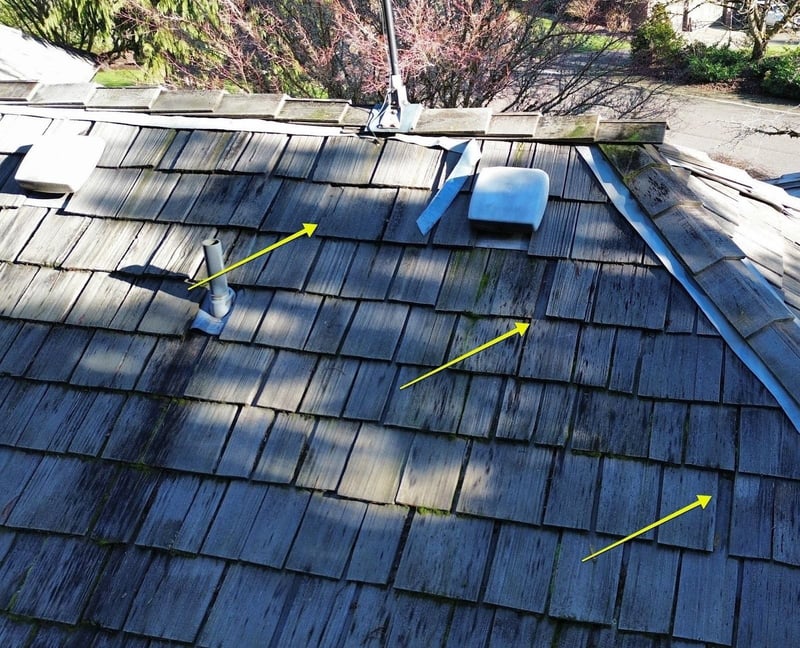
Improper Installation:
-
- No Cedar Breather: Cedar breather is a mesh mat that you’re supposed to put underneath the shakes so that they have the chance to breathe. Without it, the shake sits directly on plywood, preventing proper airflow and drying capabilities.
- Low-Quality Wood: The type of wood you use for your shake roof is very important because it dictates the quality of your roof. Cedar is the best material to use, but even within that, there are multiple levels that you can get. Premium-grade cedar is the best you can get because it won’t twist or warp after it’s cut down. Anything less than premium runs the risk of twisting.
- Lower-grade or Young-Growth Cedar: These kinds of cedar have a lot of knots and twisted grain, leading to a high failure rate. Young-growth cedar has a wide grain that twists and fails quickly.
- Southern Yellow Pine: This is a cheap substitute for cedar. The price seems really great, but it doesn’t work very well. It will be completely dead in about 10 years, and you’ll have to replace your roof again.
Repair vs Replace Cedar Shake Roof – Clear Decision Guidelines
If your wood shake roof is starting to get old, it can be difficult to decide if it’s better to repair it or just replace the whole thing. Eventually, all roofs must be replaced, but sometimes you can get away with repairing your shake roof if you only have a few specific problem areas.
It can be hard to tell if your shake roof is even having problems because a lot of the time, they look fine from far away. It’s only when you get up close that you notice problems like holes, moss, or debris build-up, and rot.
Here are some guidelines for helping you decide if a repair or replacement is better for your shake roof:
- Do a repair if:
- The repair will add 10+ years of life to the roof
- Example: Often a temporary fix (e.g., sliding a tin sheet under a broken shake to divert water). This can also include cleaning off debris or replacing shakes that are broken or missing. These solutions only work if the rest of your roof is still in decent condition.
- Example: Often a temporary fix (e.g., sliding a tin sheet under a broken shake to divert water). This can also include cleaning off debris or replacing shakes that are broken or missing. These solutions only work if the rest of your roof is still in decent condition.
- You can’t afford to do a full repair
- The repair will add 10+ years of life to the roof
- Replace the roof if:
- The roof has widespread failure
- Example: It’s covered in moss, rotting all over, or it has multiple leaks. A full replacement is the only long-term solution for a shake roof that is failing all over.
- A repair isn’t going to help (there are too many problems for a simple repair to fix)
- The roof has widespread failure
Repairs can help you extend the life of your roof, but they can only do so much for a roof that is old or just has too many problems all over the place. If you’re not sure which option is best for you, your roofer can help you decide.
| Issue | Repair Likely OK? | Replace Recommended? | Why |
|---|---|---|---|
| Isolated broken/missing shakes | Yes | No | Can add 10+ years if rest of roof is good |
| Widespread moss & rot | No | Yes | Moss holds moisture and accelerates decay |
| Multiple leaks or bad flashing | Sometimes | Usually | Indicates systemic failure |
| Excessive splitting/curling | No (if >10–20%) | Yes | Shakes no longer protect underlayment |
| Pressure-washing damage | Spot repair | If widespread | Thins wood and creates holes |
How to Prevent Problems and Extend Cedar Shake Roof Life
When you have a cedar shake roof, you have to spend a few thousand dollars on maintenance about every 5 years to keep it in good condition. This helps to keep the roof in good condition for as long as possible.
However, once the roof gets old, it’s going to look worn out and start to grow algae and moss. It’s inevitable, no matter how much money you spend. The simple truth is that cedar shake roofs are really expensive.
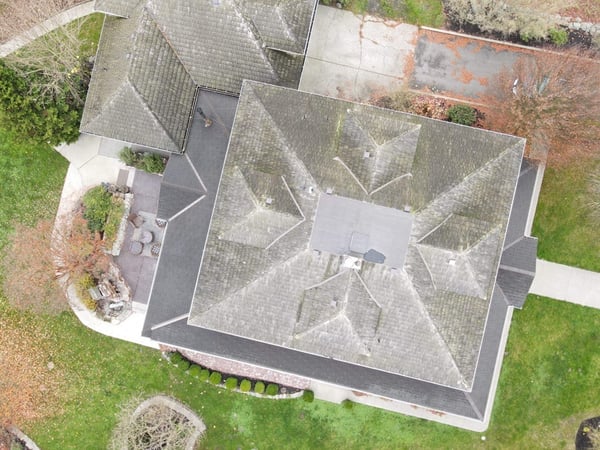
For example, we got called out to do some repairs on a 30-year-old cedar shake roof. This homeowner spent $6k–$8k on professional maintenance every 5 years, and this is what his roof looked like:
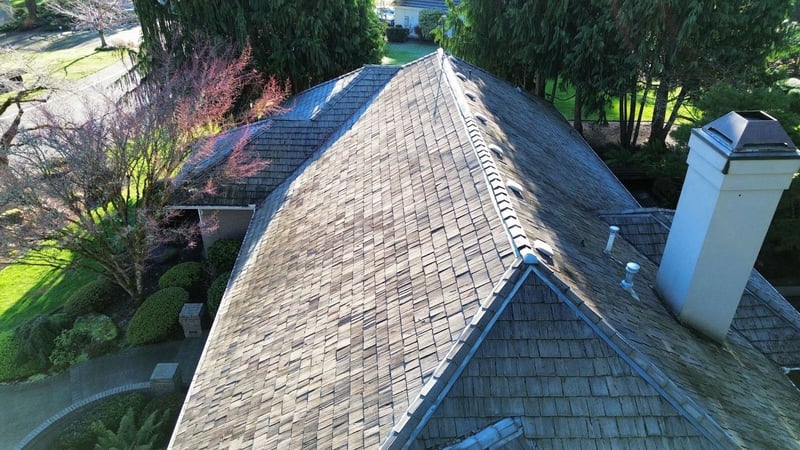
It’s not horrible, but it definitely looks old. Even though this homeowner has done a good job of keeping up with proper maintenance, his roof is still aging. By this point, he’s probably spent about as much for maintenance as he would to install a new shake roof.
How Much Does Cedar Shake Roof Replacement Cost in Seattle in 2026?
By now, you’ve seen that cedar shake roofs can be repaired in certain situations, especially when problems are isolated and the structure is still sound. But when rot, moss, splitting, and widespread failure start showing up across the roof, repairs become temporary band-aids instead of real solutions.
Cedar shake roofs are beautiful, but they’re also one of the most expensive roofing systems to maintain and replace. And if you’ve already invested thousands into upkeep over the years, it’s natural to wonder whether putting more money into repairs makes financial sense.
If replacement is on the horizon, your next question is probably about cost and what to expect in the Seattle market.
Read our article “How Much Does a Roof Cost in 2026? Prices for Seattle Homeowners” to help you understand pricing factors, material differences, and what drives the total investment so you can make a confident, informed decision about your next step.
Frequently Asked Questions
How long do cedar shake roofs last in the Seattle area?
A: With proper installation using premium-grade cedar and regular maintenance every 5 years, a cedar shake roof can last 40–50 years. In Seattle’s wet climate, however, many last only 20–30 years without consistent care due to moss, rot, and moisture buildup.
What are the biggest signs it’s time to replace rather than repair my cedar shake roof?
A: Widespread moss and rot (especially in keyways), multiple leaks or bad flashing across the roof, excessive splitting/curling of shakes (more than 10–20% of the surface), and repeated repairs that no longer add meaningful life. If repairs would only be temporary band-aids, replacement is usually more cost-effective long-term.
Can I just repair isolated damage on my cedar shake roof?
A: Yes, if the problems are truly isolated (a few broken or missing shakes, small localized leaks, or minor debris) and the rest of the roof is in good condition, targeted repairs can often add 10+ years of life. Always have a professional inspection to confirm the underlying roof is sound.
Is pressure washing safe for cedar shake roofs?
A: No. Pressure washing thins the wood, creates holes, and accelerates splitting and leaks. It is one of the most common causes of premature failure we see on Seattle cedar roofs. Use gentle moss treatments and soft cleaning methods instead.
What is a cedar breather and why does my roof need one?
A: A cedar breather is a mesh mat installed under the shakes that allows airflow and helps the wood dry out. Without it, shakes sit directly on plywood, trapping moisture and causing faster rot, a frequent issue in older or improperly installed Seattle roofs.
How much does it cost to maintain vs. replace a cedar shake roof in Seattle?
A: Maintenance (moss treatment, cleaning, and spot repairs) typically costs a few thousand dollars every 5 years. Full replacement is significantly more expensive upfront but often saves money long-term compared to repeated repairs on an aging roof. See our guide on 2026 Seattle roofing costs for current pricing.
Should I switch from cedar shake to a different roofing material?
A: Many Seattle homeowners do, especially if maintenance has become too costly or time-consuming. Lower-maintenance options like architectural asphalt, metal, or composite shakes can provide similar aesthetics with far less upkeep while still performing well in the PNW climate.
How can I prevent moss, rot, and other common cedar shake problems?
A: Schedule professional maintenance every 5 years, avoid pressure washing, use premium-grade cedar during any repairs or replacement, ensure proper installation with a cedar breather, and keep gutters/debris clear. Early moss treatment is much cheaper than dealing with advanced rot.
Do I need a professional inspection even if my cedar shake roof looks okay from the ground?
A: Yes. Roofs almost always look better from the street than they do up close. A close-up inspection can reveal hidden moss in keyways, rotting underlayment, or failing flashings before they cause interior leaks.
Topics:
