

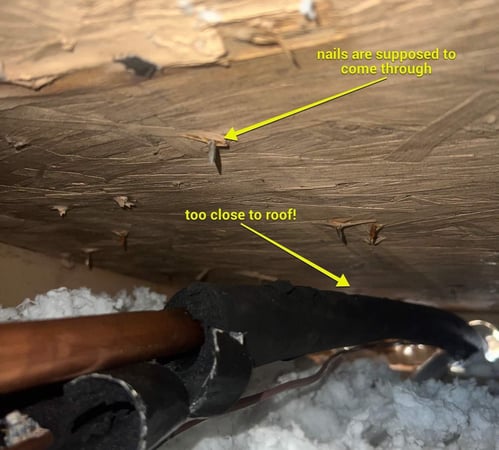
TL;DR: Summary
Your AC line shouldn’t be damaged during a roof replacement, but problems can occur if it was installed too close to the roof decking or without proper protection.
Building codes generally require protection when AC lines are installed within 1.5 inches of the roof deck, yet improper installations are common and can leave lines vulnerable to punctures from roofing nails.
If a roofer accidentally hits an AC line, the damage may not be immediately obvious, potentially leading to refrigerant leaks or reduced cooling performance. The project will be delayed while an HVAC technician makes repairs.
The key takeaway: before replacing your roof, have your attic inspected for AC lines, wiring, or plumbing installed near the roof deck so any risks can be identified and corrected before work begins.
Are you worried that your roof replacement could accidentally damage your air conditioning system and leave you with an expensive surprise after the project is finished? Have you ever wondered what happens if a roofer drives a nail into an AC line hidden beneath your roof and whether anyone would even notice right away?
AC refrigerant lines, electrical wiring, and plumbing pipes are sometimes installed too close to the roof decking, putting them directly in the path of roofing nails during a repair or replacement. When that happens, the damage can be difficult to detect and costly to fix.
At RoofSmart, we carefully inspect the roof and areas surrounding it to make sure that we find any hazards and note any extra work that needs to be done to fix your roof.
In this article, we'll explain the building code requirements for AC line placement, show you common installation mistakes roofers encounter in Seattle attics, and discuss what happens if an AC line is accidentally damaged during a roofing project and how to reduce the risk before work begins.
How Improperly Installed AC Lines Can Affect Your Roofing Project
|
Situation |
What Happens |
Risk During Roof Replacement |
Typical Solution |
|
AC line more than 1.5" from roof deck |
Meets code clearance requirements |
Low |
No action needed |
|
AC line within 1.5" of roof deck with protection |
Protected from fasteners |
Low |
Verify protection before roofing |
|
AC line within 1.5" of roof deck without protection |
Vulnerable to nail punctures |
High |
Relocate or protect line |
|
AC line touching roof decking |
Direct exposure to roofing nails |
Very High |
Immediate correction required |
|
AC line hidden beneath insulation |
Difficult to identify during inspection |
Moderate |
Careful attic inspection |
|
AC line routed through roof overhang |
Common location for installation mistakes |
Moderate–High |
Reposition line if necessary |
|
Minor nail puncture |
Small refrigerant leak |
Moderate |
HVAC repair and recharge |
|
Major puncture |
System loses refrigerant quickly |
High |
Immediate HVAC repair |
|
Properly suspended AC line |
Easily visible and protected |
Low |
Best-practice installation |
What are the building code regulations for installing AC lines?
AC lines (and other piping and wiring) are not supposed to be installed near your roof decking to avoid accidental damage during roof projects.
According to Chapter 14 of the International Residential Code (IRC), if an AC line is installed within 1.5 inches or less of the roof decking, it should be protected from damage that can be caused by nails or other fasteners.
It does not specify what kind of protection is needed in this section, but other parts of the code suggest steel plating as a protective measure for the AC line.
There are all kinds of regulations about where not to install them and how to provide proper protection in case they are installed close to the roof, but there is still plenty of freedom for installers to run the AC lines wherever they need to in the attic and elsewhere.
The IRC doesn’t require protection for AC lines if they are more than 1.5 inches from the roof decking, so ideally, installers will keep that much distance away when setting it up.
Unfortunately, AC lines and other important wiring aren’t always installed according to building code, leading to damage or other potential problems.
How can AC lines be installed incorrectly on Seattle roofs?
Despite the regulations explained in building codes, some installers still put AC lines too close to the roof without proper protection. For whatever reason, AC lines are sometimes installed right up against the roof decking, putting them at risk of being punctured by nails when the roof is repaired or replaced.
Here’s an example of an AC line that a member of our repair crew found:
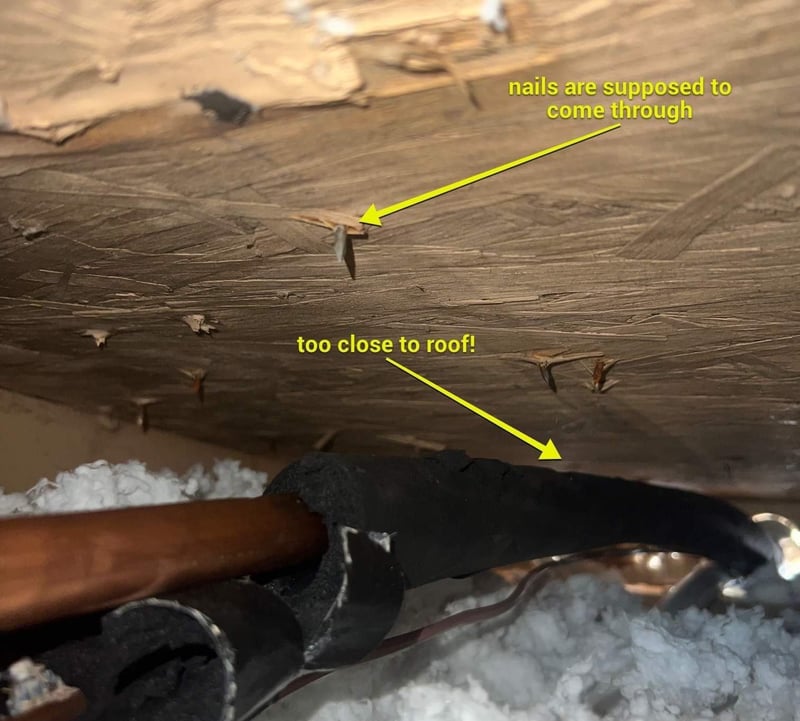
This is installed really close to the roof decking. It is covered in foam, but that is definitely not going to protect it from nails being installed with the force of a nail gun.
Other things like wiring and plumbing aren’t supposed to be installed within an inch of the roof decking either, but sometimes we still see it happen. Since there is no one “right” way to install AC lines in Seattle homes, there is a lot of room for error (or even blatant disregard for the rules).
Often, what we find is that it's more common toward the overhang, where someone wanted to run piping or wiring down the outside wall after the house was built, without getting into any drywall.
So in that picture, what you saw is a copper tube with a bend. Well, you don't want to kink it. And it's really hard for the installer to put it in a bender and then get it up and through, so they just feed it through. And it happens in the overhang.
Usually, it'll run along the ceiling joists just fine. Although the other side of that is if they have it just running along the ceiling joists (or under the insulation), then you can't see it, and you can step on it.
So it's really supposed to be kind of suspended in the middle of the attic so that you're not going to run into it, and you can clearly see it. But there isn’t a rule that specifically states that. It just needs to not be within 1.5 inches of the roof deck without protection.
Common Items Roofers Find Too Close to Roof Decking
|
Item |
Why It's a Problem |
Potential Consequence |
|
AC Refrigerant Lines |
Vulnerable to roofing nails |
Refrigerant leaks |
|
Electrical Wiring |
Can be punctured by fasteners |
Electrical hazards |
|
Plumbing Pipes |
May be damaged during tear-off |
Water leaks |
|
Low-Voltage Wiring |
Easily overlooked |
System failures |
|
Security System Wiring |
Hidden beneath insulation |
Equipment malfunction |
|
Solar System Wiring |
May be routed through attic |
Electrical repairs |
What happens if my roofer hits my AC line?
If an AC line is installed close to (under 1.5 inches) or right up against the roof decking, then it is most likely going to be hit by a nail. The two main problems in this scenario are that:
- It might take a while to notice the damage
- You’ll need to hire an AC professional to repair it
So usually it's a nick in the line (not a big rupture). And so you'll get a little bit of gas, or maybe a fluid leak.
If it’s just a small nick, it might take a while for anyone to notice that the AC line is damaged. Your roofer is operating under the assumption that there is nothing resting up against the roof decking, so they should be able to nail into it as needed. They will keep going with the roofing job because they won’t know that they hit something underneath the roof decking.
If the AC line gets punctured by one or more nails, then you’ll definitely notice that it isn’t working properly.
Obviously, if your roofer notices that an AC line or something else is touching the roof deck during the initial estimate inspection, then they will make note of it. However, it can be hard to spot because it’s hidden under insulation or behind something else.
You’ll have to call in the HVAC technician who originally installed the AC line in your home to fix it and then move it away from the roof deck to prevent this from happening again. So, this will delay your roofing project by at least a day or two (depending on how quickly you can get someone out to repair it and how much work needs to be done).
If you do not know who originally installed it or they do not have a warranty in place that requires them to fix this issue, then you’ll have to find a new HVAC technician.
How do you know if a roofing contractor is qualified to protect your home?
As you’ve seen, a roofing project can involve much more than simply replacing shingles. Hidden AC lines, electrical wiring, plumbing pipes, ventilation issues, and other unexpected obstacles can all impact the success of your roof replacement.
That's why it's so important to work with a contractor who knows how to identify these issues before they become expensive problems.
A qualified roofing contractor won't just look at the roof surface; they'll inspect the attic, identify potential hazards, communicate risks ahead of time, and have a plan for dealing with anything unusual they uncover during the project.
Read our article: “How Do I Know If a Roofing Contractor Is Qualified?” to learn how to evaluate a roofing contractor's experience, expertise, and qualifications so you can hire a team that's capable of protecting your home, avoiding costly mistakes, and delivering a high-quality roof replacement.

Frequently Asked Questions About AC Line Installation Mistakes in the Roof
1. Can roofers accidentally damage AC lines during a roof replacement?
Yes.
If an AC line is installed too close to the roof decking, roofing nails can accidentally puncture it during installation. This is most likely to happen when the line is hidden beneath insulation or installed directly against the roof deck.
2. How close can an AC line be to the roof decking?
According to building code guidelines, AC lines installed within 1.5 inches of the roof decking should have some form of protection from fasteners.
The goal is to prevent nails or screws from accidentally damaging the line during future repairs or roof replacements.
3. What happens if a roofing nail punctures an AC line?
A puncture typically causes refrigerant to leak from the system.
Depending on the size of the puncture, you may notice:
- Reduced cooling performance
- Warm air coming from vents
- Higher energy bills
- Complete AC failure
4. Will my roofer know immediately if they hit an AC line?
Not always.
Many AC line punctures are small, and the roofer may not realize damage occurred because the line is hidden beneath the roof decking. The problem often isn't discovered until the air conditioner begins malfunctioning.
5. What are signs that my AC line was damaged during roofing work?
Common signs include:
- The AC no longer cools properly
- The system runs continuously
- Refrigerant leaks
- Unusual hissing sounds
- Rising indoor temperatures
These symptoms may appear immediately or gradually over time.
6. Who repairs a damaged AC line?
An HVAC technician typically performs the repair.
The technician will:
- Locate the puncture
- Repair or replace the damaged section
- Pressure test the system
- Recharge refrigerant if necessary
7. Why are AC lines sometimes installed too close to the roof?
Installers often face challenges when routing refrigerant lines through existing homes.
Common reasons include:
- Limited attic space
- Difficult roof overhangs
- Avoiding drywall removal
- Convenience during installation
Unfortunately, these shortcuts can create problems during future roof work.
8. Are AC lines the only things roofers can accidentally hit?
No.
Roofers occasionally encounter:
- Electrical wiring
- Plumbing pipes
- Low-voltage wiring
- Communication cables
Any system installed too close to the roof deck may be vulnerable to accidental damage.
9. Can a roofing inspection identify AC line problems before work begins?
Sometimes.
A thorough attic inspection can reveal exposed AC lines, but not every issue is visible. Lines hidden beneath insulation or tucked into tight spaces may be difficult to identify before the roof is removed.
10. How can homeowners reduce the risk of AC line damage during a roof replacement?
Before work begins:
- Ask your roofer to inspect the attic
- Identify any HVAC components near the roof deck
- Notify the roofer about previous HVAC work
- Consider having an HVAC contractor evaluate questionable installations
Taking these steps can help prevent delays, repairs, and unexpected costs during the project.
Topics:
