

TL;DR: Summary
Installing a pedestal system on your rooftop deck helps prevent moisture problems by raising the deck tiles above the roof membrane, giving water room to drain or evaporate instead of becoming trapped underneath. This is especially important in Seattle, where poor drainage and trapped moisture can contribute to leaks, rot, and other rooftop deck damage.
Pedestal systems also make the roof easier to inspect and maintain because individual tiles can be removed to access the membrane and drainage system underneath. Compared to long wooden planks, which can trap moisture, swell, warp, and become difficult to remove, tiles installed on pedestals provide better drainage and accessibility.
The key takeaway: a pedestal system can help your Seattle rooftop deck manage moisture more effectively while making future inspections and repairs easier. When combined with proper insulation, drainage, and waterproofing, it can help protect the rooftop deck from the costly moisture problems that commonly affect poorly designed systems.
Did you buy a newer Seattle townhouse expecting the rooftop deck to last for years, only to discover leaks, rotting wood, or standing water much sooner than you expected? Are you worried that replacing the damaged decking will only lead to the same expensive problems again if water still gets trapped underneath it?
At RoofSmart, we've seen these problems on Seattle rooftop decks and helped fix them over a hundred times. For two sets of townhouse owners I recently worked with, those problems had progressed far enough that one homeowner discovered a major leak coming through the shower ceiling.
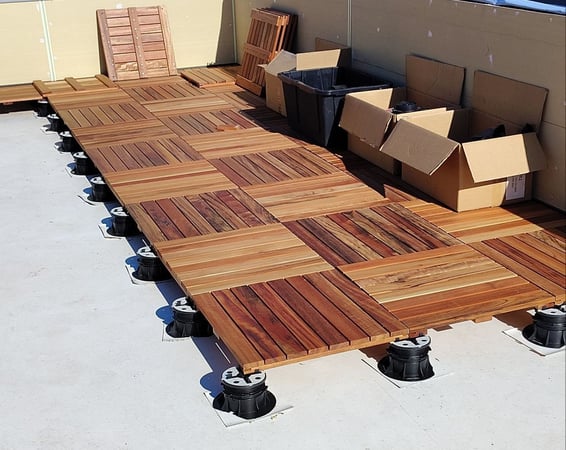
In this case study, I'll show you what went wrong with this rooftop deck, explain why we replaced the long wood planks with tigerwood tiles on a raised pedestal system, and walk through how this setup gives rainwater room to drain and evaporate while making the roof underneath much easier to inspect and maintain.
What common problems do rooftop decks in Seattle have?
Rooftop decks in Seattle, especially on newly built townhomes in Seattle, can easily face moisture issues like condensation and leaks. It is a problem that I see all the time when I am inspecting them.
For example, I recently had a set of customers who purchased a Seattle townhouse that was split into two units. Each couple bought their new place, both thinking they weren't really going to have to do work on the rooftop deck for a while because it's not that old.
However, I was originally called out because one couple noticed a huge leak in one of their showers coming through the ceiling all of a sudden. The couple in the other unit also decided to hire RoofSmart after I noticed issues across both of their rooftop decks:
- No Thermal Break: The roof lacked insulation above the deck, allowing warm, moist air rising from the living spaces in the units to hit the cold roof decking and create condensation. This condensation seeped into the roof decking and caused it to rot.
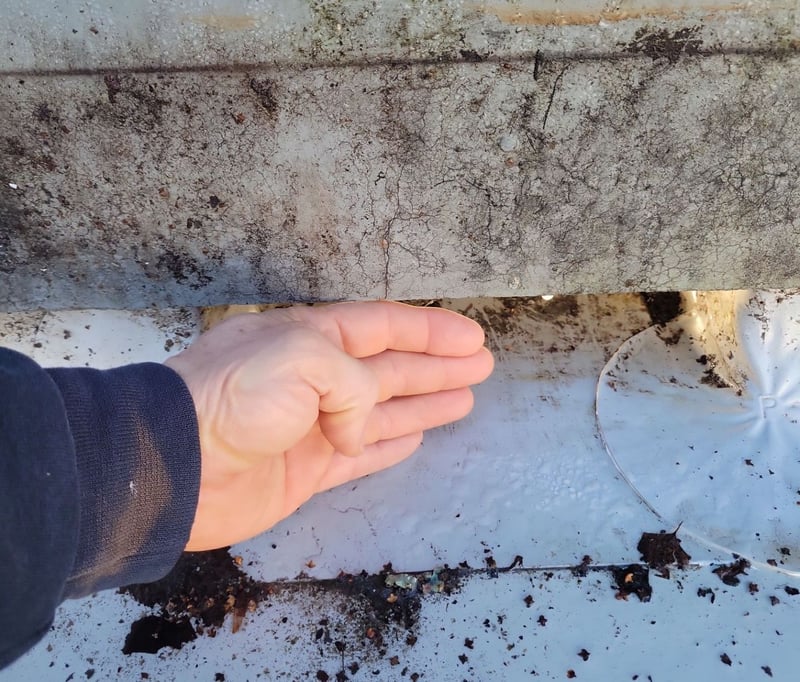
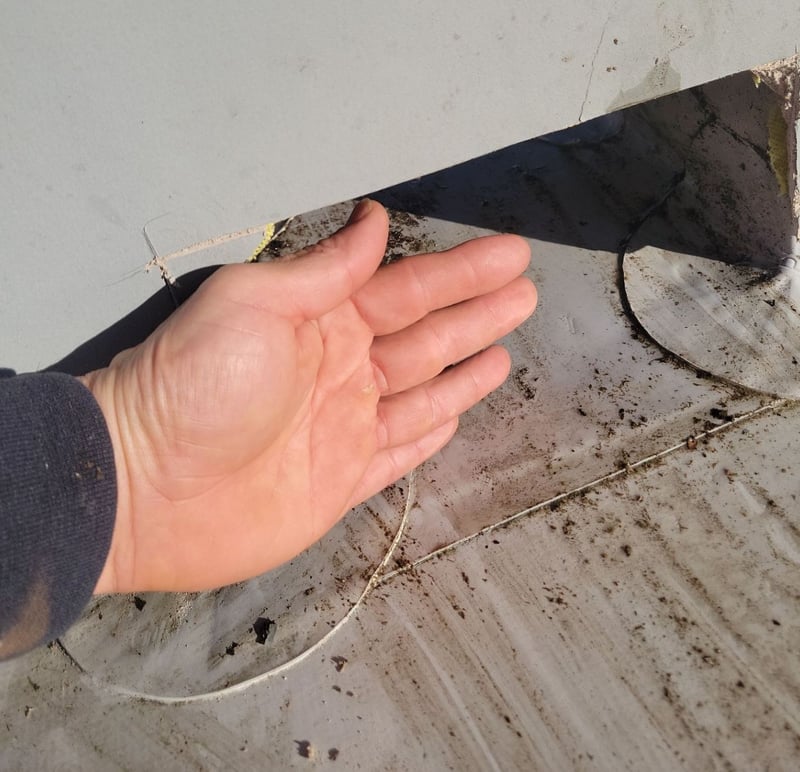
- Poor Scupper Drainage: Anytime there was a decent amount of rain, it would just overwhelm the scupper, and the water would go straight into the roof, causing a huge leak. The scupper was also partially blocked due to the sloppy way it was built, which made the drainage issues worse. In addition, the material at the top of the scupper opening was not welded shut, so the water could easily enter the roof up top anytime there was too much water in the scupper. Check out the difference in these before-and-after photos from the front and back, using our repair guy’s hand for reference:
- Damaged Wooden Slat Deck: And anytime you're doing long wooden slats on a rooftop deck, it’s going to have problems because water will get underneath the wood all the time. That trapped water needs to either drain or evaporate (or some combo of the two). And if you have these long slats of wood, especially if they're butting up against each other and the sides, then you just have moisture just like collecting underneath it constantly without anywhere to escape, causing the wood to swell in unpredictable ways. It didn’t help that the wood was a lower-quality variety that made it more susceptible to this type of damage. And in this case, it was also secured with screws, so the wood swelled around the screw. This made trying to get the screws out a huge pain, especially if you just wanted to check on drainage. The deck was also screwed into the siding, which wicked water into the Hardy Plank material. Overall, the planks were in poor condition.
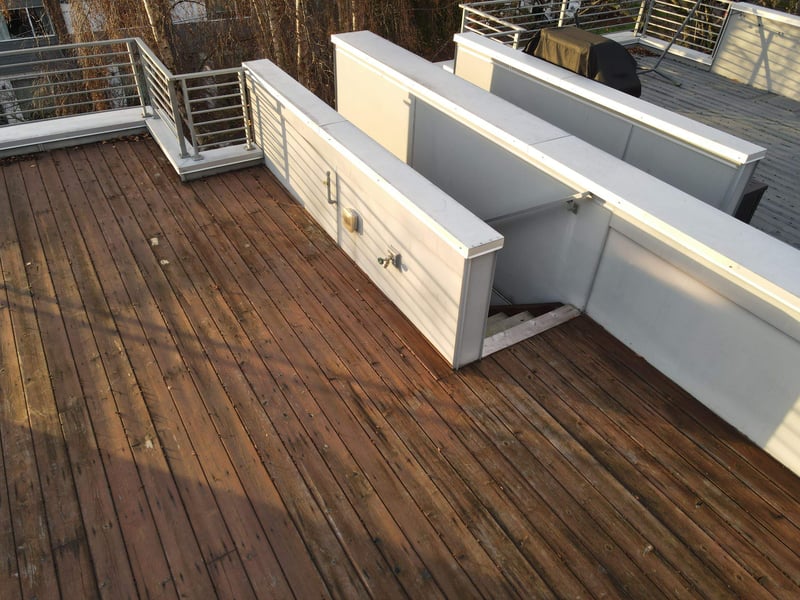
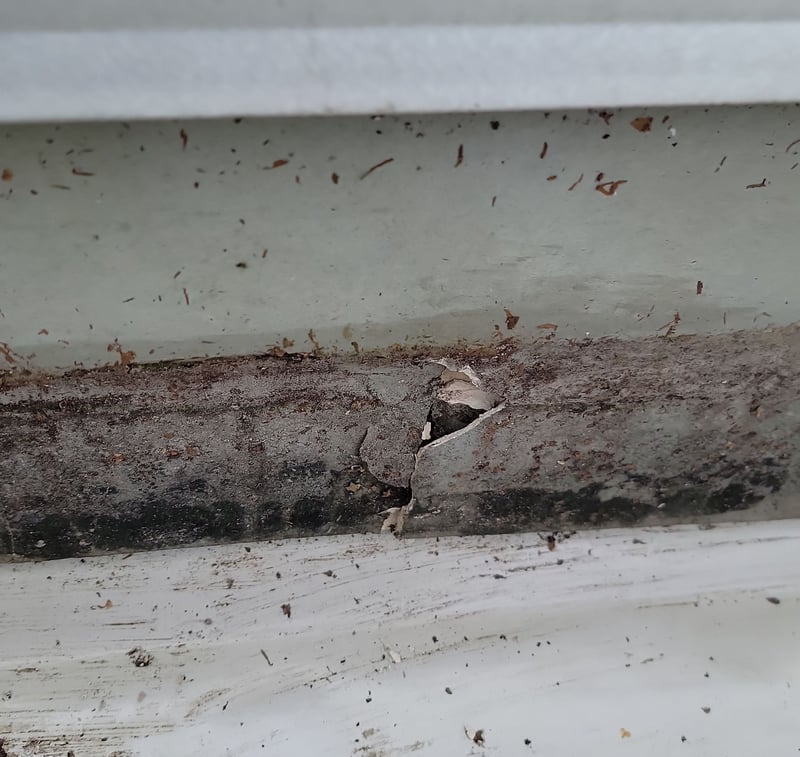
The flaws caused a major leak into a shower ceiling, prompting the homeowners to call RoofSmart.
This house wasn’t built that long ago, yet the rooftop deck was already facing all kinds of moisture problems due to poor installation.
How does installing roof tiles on a pedestal system protect your rooftop deck from damage?
I recommend installing tiles on a raised pedestal system instead of using long wooden planks for customers with a rooftop deck because it provides these benefits:
- You have easy access to the entire roof: If you need it, you can remove any of the tiles to check the roof underneath. This is useful if you want to check the drainage or if you’re worried about a leak or some other issue in a particular spot.
- Water can evaporate or flow to the scuppers: Since the roof tiles are installed on an elevated platform, there is room for the water to escape instead of getting trapped inside your rooftop deck.
- Preventing warping or swelling: The tiles don’t absorb water because it can flow to the scuppers or evaporate, which helps to protect the tiles from damage caused by absorbing water. Instead of warping or swelling, they’ll maintain their shape.
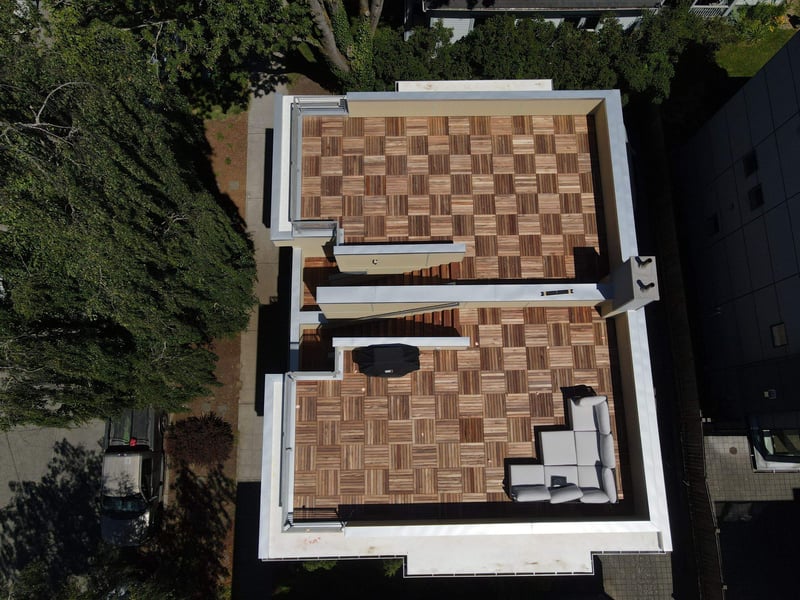
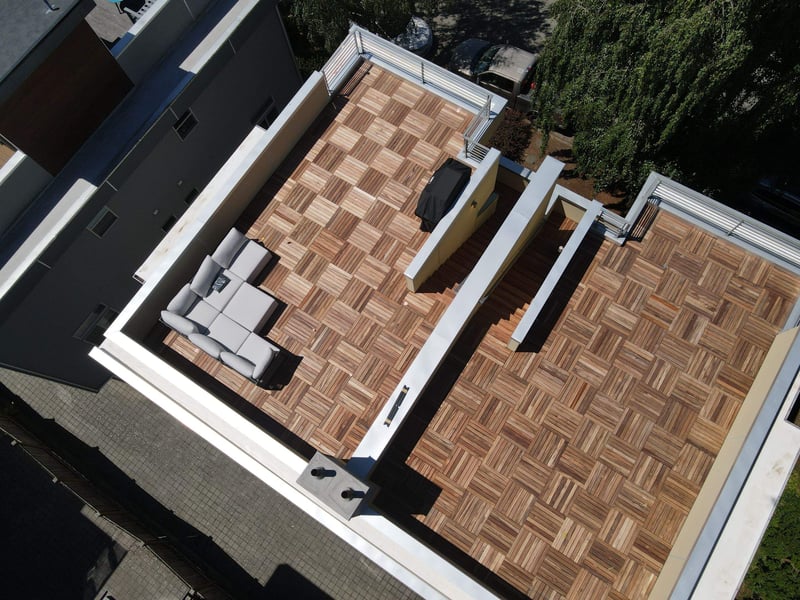
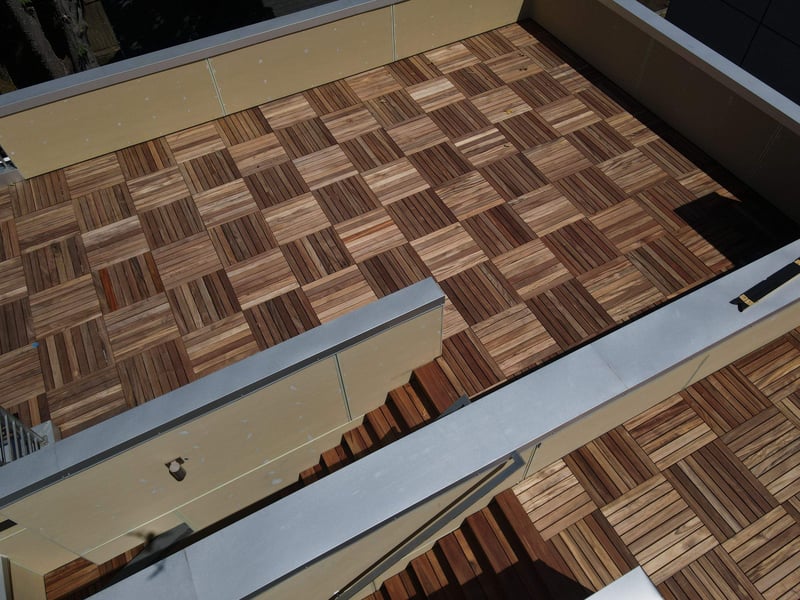
These customers ended up choosing tiles made of tigerwood, which is a hardwood alternative to Ipe (a commonly used rooftop deck material). It has a nice natural color and is less expensive than Ipe. The only downside is that it has a somewhat shorter lifespan.
Here’s how it turned out:
Benefits to Rooftop Deck Pedestal Systems
|
Feature |
Rooftop Deck With a Pedestal System |
Rooftop Deck With Long Wood Slats |
|
Drainage |
Elevated tiles leave space for water to flow toward scuppers and drains |
Water can become trapped beneath long boards |
|
Drying |
Open space beneath tiles allows moisture to evaporate |
Closely installed boards can limit airflow and trap moisture |
|
Access to roof membrane |
Individual tiles can be removed to inspect the membrane or drainage system |
Screwed-down boards can make accessing the roof underneath difficult |
|
Leak inspection |
Specific tiles can be lifted to investigate suspected leaks |
Larger sections of decking may need to be removed |
|
Water-related movement |
Tiles are less susceptible to the swelling and warping described with the previous deck |
Wood slats can swell and move when repeatedly exposed to trapped moisture |
|
Drain maintenance |
Easier to access scuppers and drainage areas |
Decking can make drainage areas more difficult to inspect |
|
Repairs |
Individual tiles can be removed and reinstalled as needed |
Removing screwed-down boards can be time-consuming |
|
Seattle climate |
Helps give rainwater and moisture a path to drain or evaporate |
Trapped moisture can be especially problematic in Seattle's wet climate |
|
Material options |
Can accommodate deck tiles such as tigerwood |
Commonly constructed using long wood planks or slats |
|
Best for |
Homeowners prioritizing drainage, accessibility, and easier inspection |
Homeowners willing to accept more difficult access beneath the finished deck |
What other steps did RoofSmart take to protect this rooftop deck?
In addition to installing a new rooftop deck, here are the other updates the RoofSmart crew made to the roof of this townhouse:
- Redid the stairs in addition to the actual rooftop deck
- Replaced all of the rotting wood on the rooftop deck and added proper insulation
- We reused their existing railing, but had to bump it up
One big challenge that our roofing crew faced during this project was accessing the property. This is a multi-story building with not a lot of space between it and the next building over. There wasn’t even a driveway we could pull into.
The crew had to park on the street and get creative to transport materials on and off the roof. To discard rotten wood and other materials they weren’t using, they set up a chute that was directed toward the dump trailer.
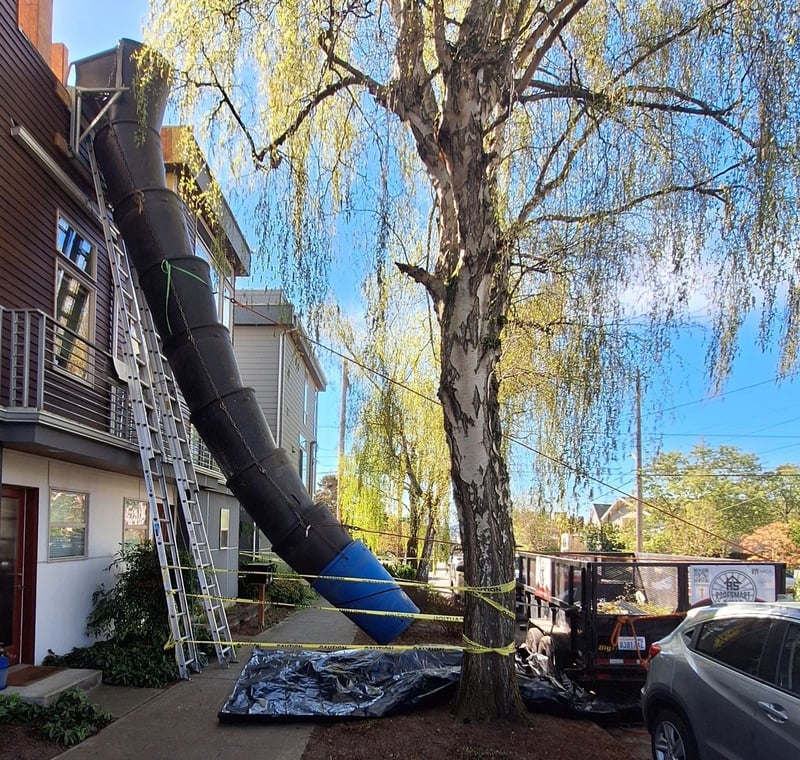
To send materials up, they used a laddervator that could carry roofing items up several stories.
This extra time and effort was one reason that the job cost more than it might have on a property with easier access.
In the end, the homeowners were very satisfied with the crew’s high-quality work and attention to detail.
Are wood tiles better than long wood planks for a Seattle rooftop deck?
As these homeowners discovered, the finished surface of your rooftop deck can have a major impact on how well the entire system manages Seattle's persistent moisture. Long wood planks can trap water underneath, swell or warp, and make it difficult to access the roof membrane and drains when something goes wrong.
Installing wood tiles on a pedestal system addresses many of those concerns. The raised design gives water space to drain or evaporate, while removable tiles make it much easier to inspect the membrane, clean drainage areas, and investigate a potential leak before it causes extensive hidden damage.
Read our article “Wood Tile vs. Long Planks: Which Is Better on a Seattle Rooftop Deck?” To get a comparison of the two options in more detail, including drainage, maintenance, durability, accessibility, and the tradeoffs you should consider before choosing the finished surface for your rooftop deck.
Frequently Asked Questions About Rooftop Deck Pedestal Systems
1. What is a pedestal system for a rooftop deck?
A pedestal system is a raised support system that holds deck tiles above the waterproof roof membrane. The space underneath the tiles gives water room to flow toward the roof's scuppers or drains and allows moisture to evaporate instead of becoming trapped beneath the finished deck surface.
2. Are pedestal systems good for rooftop decks in Seattle?
Yes. A pedestal system can be particularly beneficial in Seattle because rooftop decks regularly deal with rain and moisture.
The raised design helps water drain beneath the deck tiles while creating space for evaporation. It also makes it easier to access the roof membrane and drainage system if you suspect a leak or clog.
3. How does a pedestal system improve rooftop deck drainage?
Instead of installing the finished deck surface directly against the roof, pedestals elevate the tiles. Water that gets underneath the tiles can then move across the waterproof membrane toward the scuppers or other drainage points.
The pedestal system doesn't replace proper drainage, though. The underlying roof still needs to be designed so that water flows toward its drains.
4. Can a pedestal system help prevent rooftop deck leaks?
A pedestal system doesn't waterproof the roof by itself, but it can make the rooftop deck easier to inspect and maintain.
Because individual tiles can be removed, you can access the membrane and drainage system underneath. That can make it easier to investigate a suspected leak or drainage problem without dismantling large sections of the finished deck.
5. Why are long wooden planks problematic on a rooftop deck?
Water can become trapped underneath long wood planks, particularly when the boards are installed closely together or against surrounding surfaces.
That trapped moisture needs somewhere to drain or evaporate. Without adequate drainage and airflow, wooden boards can absorb moisture, swell, warp, and become difficult to remove, especially when they're secured with screws.
6. Can I access my roof membrane after installing deck tiles on pedestals?
Yes. Easy access is one of the biggest benefits of a pedestal system.
Individual tiles can be lifted when you need to inspect the membrane, check drainage, clean an area, or investigate a potential leak. Afterward, the tile can be put back into place.
7. Does a pedestal system prevent standing water?
A pedestal system helps water move underneath the finished deck surface, but it cannot fix an improperly designed roof by itself.
Your rooftop deck still needs properly designed drainage, including functional scuppers or drains. If the underlying roof doesn't direct water toward those drainage points, you can still experience ponding water.
8. What type of deck tiles can be installed on a pedestal system?
The project described in this article used tigerwood tiles. Tigerwood is a hardwood alternative to Ipe that provides a natural wood appearance at a lower price, although it may have a shorter lifespan than Ipe.
The important distinction is that the tiles sit on the raised pedestal system rather than being installed as long wooden boards directly across the rooftop deck.
9. Does installing a pedestal system eliminate condensation problems?
No. Condensation and surface drainage are separate issues.
A pedestal system helps manage water above the roof membrane, while condensation can develop within the roof assembly. In the Seattle townhouse discussed here, the roof also needed proper insulation above the roof deck to create a thermal break and address the condensation problem.
10. Is a pedestal system worth it for a Seattle rooftop deck?
It can be worth considering if you want better access, drainage, and moisture management from your finished deck system.
Compared with long, screwed-down wooden planks, removable tiles on pedestals give water more opportunity to drain or evaporate and make the underlying roof significantly easier to inspect. For Seattle rooftop decks that regularly deal with moisture, those advantages can make future maintenance and troubleshooting much easier.
Topics:
