

Are you uncertain if the Malarkey Standard Warranty gives you enough protection if something goes wrong years from now? Are you worried that paying more to qualify for Malarkey’s Certified Premium Warranty might not be worth it because exclusions or fine print could still leave you paying for repairs you thought would be covered?
At RoofSmart, we believe it’s important for our customers to understand what they’re getting into when they choose a roof material and warranty. Each year, we help hundreds of homeowners decide which warranty is right for them by being honest about what kind of coverage each one offers.
Roofing warranties can be difficult to compare because “lifetime” coverage doesn’t necessarily mean every expense is fully covered for the life of your roof.
In this article, I’ll compare Malarkey’s Standard and Certified Premium warranties side by side and break down the exclusions that apply to both warranties so you can better understand what could void your coverage and decide which level of protection makes sense for your roof.
Quick Answers
Malarkey’s Standard and Certified Premium warranties both cover defective shingles, but the Certified Premium Warranty provides more comprehensive protection, including a 50-year non-prorated period, 25 years of workmanship coverage, Enhanced Wind Warranty coverage, some low-slope coverage, and pays for tear-off and disposal costs. The Standard Warranty provides baseline coverage with fewer eligibility requirements, but its non-prorated period is only 10 to 20 years depending on the shingle.
The Certified Premium Warranty has stricter requirements: your roof must be installed by a Malarkey Certified Premium contractor using Malarkey shingles and at least four qualifying accessories, along with meeting other installation requirements. Both warranties also share important exclusions, including improper installation, inadequate attic ventilation, impact damage, mold or moss, third-party work, and roof traffic damage.
The key takeaway: Malarkey’s Standard Warranty may be enough if you only want basic manufacturer coverage, while the Certified Premium Warranty is worth considering if you want longer non-prorated protection, workmanship coverage, and more comprehensive benefits. Keep in mind that qualifying for the premium warranty may increase your roof replacement cost.
What are the differences in coverage between Malarkey’s Standard and Certified Premium warranties?
Although both warranties provide coverage for defective shingles, there are several key differences in coverage between the standard and premium warranties. The premium warranty has longer and more comprehensive coverage than the standard warranty:
Eligibility requirements: Anyone who has Malarkey shingles installed on their roof is eligible for the standard warranty. But to access a premium warranty, your roof must meet several requirements, including:
- Being installed by a Malarkey Certified Premium contractor
- Install Malarkey shingles and a minimum of 4 Malarkey accessories
- Having the right kind of sheathing that is in good condition
Different wind coverage requirements: With the standard warranty, you can choose between the Limited Wind Warranty (covers winds up to 110 MPH) or the Enhanced Wind Warranty (covers winds up to 130 MPH). For the Enhanced Wind Warranty, you need additional Malarkey accessories installed. Both options offer 15 years of wind warranty coverage. Because the premium warranty has specific eligibility requirements, you automatically get the Enhanced Wind Warranty coverage also for 15 years.
Non-prorated period varies: If you have a standard warranty, you have lifetime coverage, but the non-prorated period is 10 to 20 years (depending on the type of shingle you install). With the premium warranty, you get lifetime coverage with a 50-year non-prorated period no matter which shingles you install.
Low slope warranty coverage: The standard warranty does not have a section dedicated to low-slope roofs, but the premium warranty does offer some coverage. It provides coverage for up to 10 squares of your low-slope roof if you meet the requirements for a setup on a low slope. The coverage period ranges from 12 to 17 years depending on the type of roof you get.
Workmanship coverage: The premium warranty includes 25 years of coverage for workmanship issues, but that is not available through the standard warranty.
Including tear-off and disposal: Both the standard and premium warranty state that it will provide coverage for repair or replacement costs for defective shingles (or their other products) at their discretion. The standard warranty does not cover tear-off or disposal of the old roofing material, but the premium warranty does include it (if Malarkey deems it necessary for a repair).
Each warranty includes a table with an overview of this information:
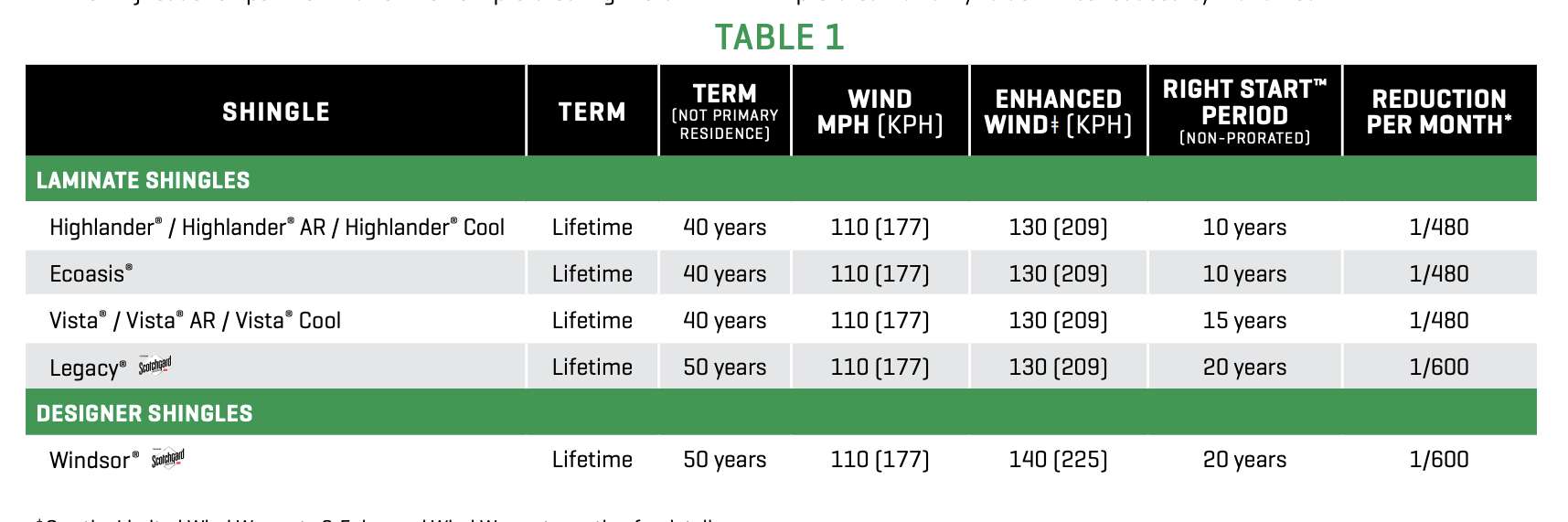
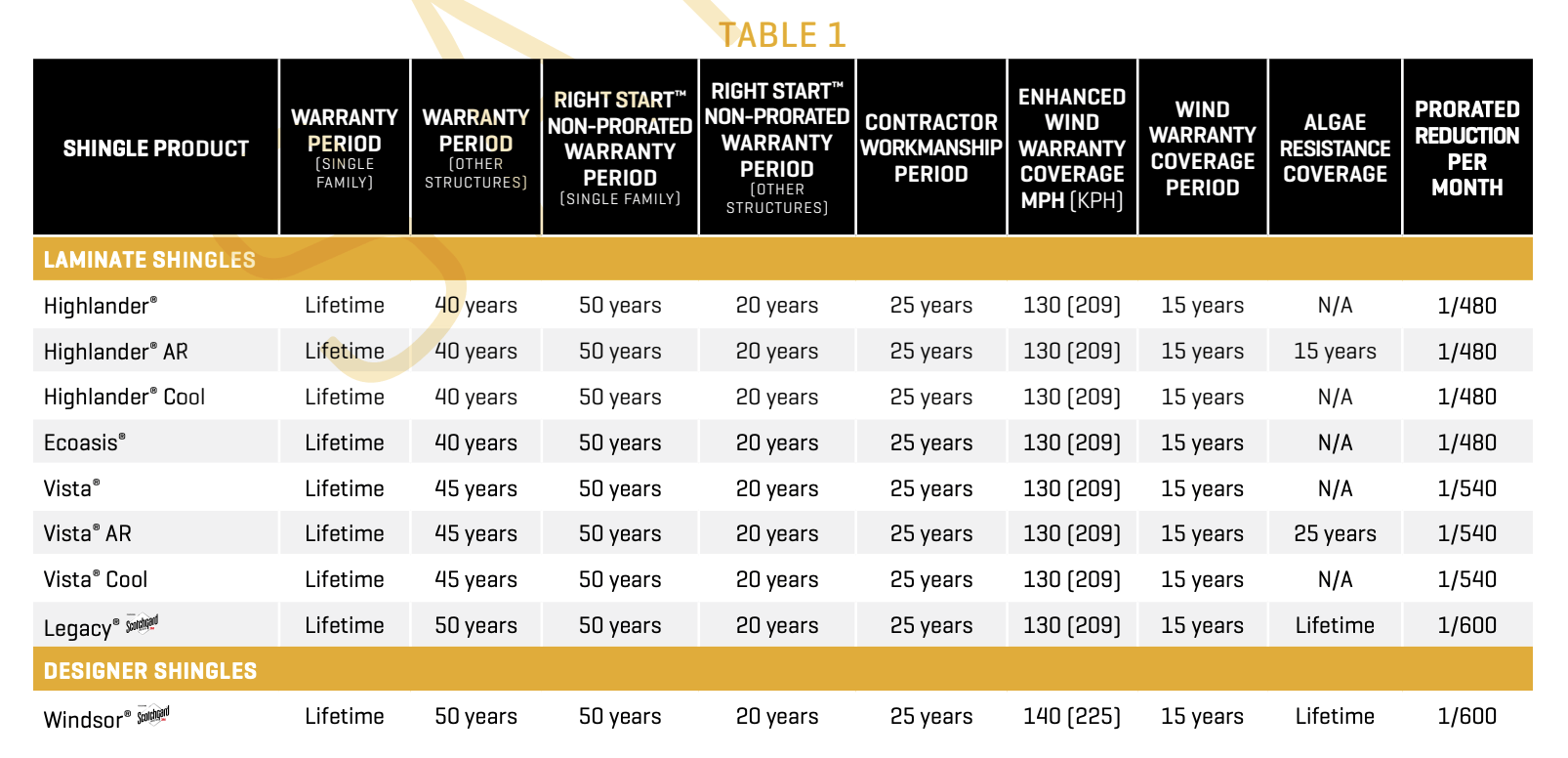
Malarkey Standard vs. Certified Premium Warranty Comparison Table
| Warranty Feature | Malarkey Standard Warranty | Malarkey Certified Premium Warranty |
|---|---|---|
| Basic eligibility | Available with Malarkey shingles | Must meet additional eligibility requirements |
| Contractor requirement | No Certified Premium contractor requirement stated | Roof must be installed by a Malarkey Certified Premium contractor |
| Malarkey accessories required | Additional accessories required for Enhanced Wind Warranty | Minimum of 4 Malarkey accessories required |
| Roof deck/sheathing requirement | Standard installation requirements apply | Sheathing must be the appropriate type and in good condition |
| Wind coverage | Limited Wind Warranty up to 110 MPH or Enhanced Wind Warranty up to 130 MPH | Enhanced Wind Warranty up to 130 MPH included when eligibility requirements are met |
| Wind coverage period | 15 years | 15 years |
| Overall warranty term | Lifetime coverage | Lifetime coverage |
| Non-prorated period | 10 to 20 years, depending on shingle | 50 years, regardless of shingle selected |
| Low-slope coverage | No dedicated low-slope warranty section | Coverage for up to 10 squares when low-slope installation requirements are met; coverage period ranges from 12 to 17 years depending on roof type |
| Workmanship coverage | Not included | 25 years |
| Defective shingle repair/replacement | Included according to warranty terms | Included according to warranty terms |
| Tear-off and disposal | Not covered | Included when Malarkey determines tear-off is necessary for the repair |
| Algae coverage | Lifetime for Scotchgard-protected shingles; 15 or 25 years for AR shingles depending on product | Same general algae coverage periods, with premium-specific proration provisions for Scotchgard shingles |
| Main advantage | Baseline manufacturer coverage without Premium eligibility requirements | Longer non-prorated protection plus workmanship, tear-off/disposal, and certain low-slope coverage |
Are there any similarities in coverage between Malarkey’s Standard and Certified Premium Warranties?
Although there are several differences between the standard and premium warranties, there is one similarity. No matter the level of warranty, each one has the same requirements and coverage length for its algae warranty.
Both warranties provide lifetime coverage for shingles with Scotchgard protection and 15 or 25 years of warranty coverage (depending on the shingle) for Algae Resistant [AR] shingles. AR shingles have a non-prorated period of 10 years under both warranties, but the premium warranty does prorate coverage for Scotchgard shingles after 20 years.
What exclusions do the Standard and Certified Premium Malarkey warranties have?
All the same exclusions apply to the Standard and Certified Premium Malarkey warranties. Most are similar to the typical exclusions that you see in a manufacturer’s warranty, saying coverage is void if:
- Proper installation instructions were not followed
- Poor workmanship caused damage
- Attic ventilation doesn’t meet code
- Third-party work was done on the roof
- Defective non-Malarkey products caused damage
- Impact damage
- Damage from mold, moss, or mildew
- Shading
- Damage from natural disasters
All of these exclusions are present in the Standard and Certified Premium Malarkey warranties, and some variation of them can be found in pretty much any shingle manufacturer’s warranty as well.
One particular exclusion that is fairly unique to Malarkey is damage caused by traffic on the roof, including for algae and debris removal.
This exclusion might potentially cause trouble because, as a homeowner, you are responsible for keeping moss and debris off your roof, but you might also lose your warranty coverage if you damage your roof while removing these items. Even just one small scuff could be enough to get your warranty voided.
How do I decide which Malarkey warranty is right for my roof?
If you are someone who is fine with baseline coverage and doesn’t really plan on relying on the warranty, then the standard warranty is a good fit for you. However, if you want to make sure that you have the most coverage possible in case there is a problem with your roof, then you should consider getting the premium warranty.
Deciding which Malarkey warranty is right for you all comes down to how much coverage you want to have.
Keep in mind that cost is another factor. The Malarkey Certified Premium Warranty requires you to install a certain amount of Malarkey products and follow stricter installation instructions, so it’s possible that it will cost you more.
Does a Malarkey Roofing Warranty Fully Protect Your Roof?
Choosing between Malarkey’s Standard and Certified Premium warranties means deciding how much protection you want and what requirements you’re willing to meet to get it. The Standard Warranty provides baseline manufacturer coverage, while the Certified Premium Warranty adds significant benefits, including a 50-year non-prorated period, 25 years of workmanship coverage, tear-off and disposal coverage in qualifying situations, and certain low-slope protection.
However, upgrading your warranty doesn’t mean every future roofing problem will be covered. Both Malarkey warranties contain exclusions related to installation, attic ventilation, third-party work, impact damage, moss and mold, natural disasters, and even damage caused by foot traffic on the roof.
That’s why you shouldn’t assume that having a manufacturer’s warranty means you’ll automatically be protected if your roof develops a problem.
Read our article “Does Having a Manufacturer’s Warranty Mean Your Roof Is Protected?” to learn what roofing warranties really protect you from, what they typically exclude, and what you should understand before relying on one to cover a future roofing problem.
Want to see how we'd look at your roof?
Start with a SmartMatch™ Needs Analysis, or call (206) 487-4877.
Frequently Asked Questions About Malarkey Standard and Certified Premium Warranties
1. What is the biggest difference between Malarkey's Standard and Certified Premium warranties?
The biggest difference is the length and scope of coverage. Both warranties provide protection for qualifying defective Malarkey products, but the Certified Premium Warranty provides several additional benefits.
Most notably, the Premium Warranty includes a 50-year non-prorated period, 25 years of workmanship coverage, qualifying low-slope coverage, and tear-off and disposal coverage when Malarkey determines those steps are necessary for a covered repair.
2. How long is Malarkey's non-prorated warranty coverage?
Under the Standard Warranty, the non-prorated period ranges from 10 to 20 years depending on the Malarkey shingle installed.
The Certified Premium Warranty extends the non-prorated period to 50 years regardless of which qualifying Malarkey shingle you choose. This is one of the most significant coverage differences between the two warranty levels.
3. What do I need to qualify for a Malarkey Certified Premium Warranty?
A Premium Warranty has more requirements than Malarkey's Standard Warranty. According to the warranty requirements discussed in this article, the roof must be installed by a Malarkey Certified Premium contractor, include Malarkey shingles and at least four Malarkey accessories, and have appropriate sheathing that's in good condition.
Because of these requirements, homeowners interested in Premium coverage should discuss warranty eligibility with their roofing contractor before installation rather than assuming the roof can be upgraded to Premium coverage afterward.
4. Does the Malarkey Certified Premium Warranty cover workmanship?
Yes. The Certified Premium Warranty provides 25 years of workmanship coverage, while that workmanship protection isn't included with the Standard Warranty.
This can be an important distinction because a roofing problem isn't always caused by a defective shingle. Some failures are related to how the roofing system was installed.
5. What wind damage does the Malarkey warranty cover?
Under the Standard Warranty, homeowners can qualify for either a Limited Wind Warranty up to 110 MPH or an Enhanced Wind Warranty up to 130 MPH. Additional Malarkey accessories are required to qualify for the Enhanced Wind Warranty.
Both provide 15 years of wind coverage. Because the Certified Premium Warranty already has stricter system requirements, qualifying Premium installations receive the Enhanced Wind Warranty for 15 years.
6. Does the Malarkey warranty cover low-slope roofing?
The Standard Warranty discussed in this article doesn't have a dedicated section providing the same low-slope coverage available through the Premium Warranty.
The Certified Premium Warranty can cover up to 10 squares of qualifying low-slope roofing, provided the installation meets Malarkey's low-slope requirements. The coverage period ranges from approximately 12 to 17 years, depending on the roofing product.
7. Does Malarkey's warranty pay for tearing off defective shingles?
There is an important difference between the two warranty levels. The Standard Warranty can provide repair or replacement coverage for qualifying defective products, but tear-off and disposal aren't included.
The Certified Premium Warranty can include tear-off and disposal when Malarkey determines those steps are necessary to complete a covered repair. That can reduce an important out-of-pocket expense if a qualifying warranty problem occurs.
8. What does Malarkey's warranty cover for algae?
Both warranty levels provide the same basic coverage lengths for algae. Shingles with Scotchgard protection receive lifetime algae coverage, while Algae Resistant (AR) shingles receive either 15 or 25 years, depending on the shingle.
AR shingles have a 10-year non-prorated period under both warranties. The Certified Premium Warranty also has specific proration provisions for Scotchgard-protected shingles after 20 years.
9. What can void a Malarkey shingle warranty?
Both the Standard and Certified Premium warranties contain important exclusions. Examples discussed in this article include improper installation, inadequate attic ventilation, damage caused by poor workmanship, third-party roof work, defective non-Malarkey products, impact damage, mold, moss or mildew, shading, natural disasters, and roof traffic.
The roof-traffic exclusion is especially important for maintenance. Homeowners are responsible for keeping debris and moss under control, but damage caused while someone is walking on the roof to perform that maintenance may affect warranty coverage.
10. Is the Malarkey Certified Premium Warranty worth getting instead of the Standard Warranty?
The answer depends on how much warranty protection you want and whether the additional installation requirements make sense for your project.
The Standard Warranty provides baseline manufacturer coverage without requiring the complete Certified Premium roofing system. The Premium Warranty requires a Certified Premium contractor, additional Malarkey components, and stricter installation requirements, which can increase the project's upfront cost. In exchange, it provides a 50-year non-prorated period, 25 years of workmanship coverage, qualifying low-slope protection, and potential tear-off and disposal coverage that aren't included with the Standard Warranty.
Topics:
