

TL;DR: Summary
Collar ties and rafter ties serve different structural purposes, and many stick-framed roofs need both to remain safe and stable. Rafter ties prevent the exterior walls from spreading under the roof's weight, while collar ties help keep strong winds from pulling the rafters apart.
Homes built with prefabricated trusses typically don't require separate collar or rafter ties because the truss system provides the necessary structural support. However, stick-framed roofs that are missing these components may be vulnerable to sagging roofs, bowing walls, or even structural failure.
If your roof appears to be underframed, the solution may involve significant framing repairs during a roof replacement, often requiring input from an experienced roofer or structural engineer.
The key takeaway: collar ties and rafter ties are not interchangeable. Understanding which one your roof needs is essential for protecting your home's structural integrity and ensuring your roof can safely withstand both gravity and wind loads.
Have you noticed your roof starting to sag and wondered if your home has a serious structural problem? Are you confused by terms like collar ties and rafter ties, and worried that missing a crucial piece of framing could be putting your roof or your family's safety at risk?
Collar ties and rafter ties may look similar, but they serve two very different structural purposes. One helps keep your roof from lifting apart during high winds, while the other prevents the weight of the roof from pushing your exterior walls outward.
At RoofSmart, we have helped more than 100 customers improve their roof’s framing, either by adding the proper amount or redesigning the entire roof. Not all roofers are experienced in framing and carpentry, but we prefer to be prepared to help with any roof issues that our customers may have.
In this article, we'll explain the difference between collar ties and rafter ties, when your roof needs each one, how to recognize the warning signs that your framing may be inadequate, and what your options are if your roof is missing these critical structural supports.
Collar Ties vs. Rafter Ties
|
Feature |
Collar Ties |
Rafter Ties |
|
Location |
Upper third of the rafters |
Lower third of the rafters |
|
Primary Purpose |
Prevent wind uplift from separating rafters |
Prevent walls from spreading outward under roof load |
|
Main Force Resisted |
Uplift |
Outward thrust |
|
Required On |
Most stick-framed roofs |
Most stick-framed roofs (or ceiling joists serving the same purpose) |
|
Used with Trusses? |
Not typically needed |
Not typically needed |
|
Can Ceiling Joists Replace Them? |
No |
Yes, in many roof designs |
|
Common Signs They're Missing |
Ridge separation, wind-related movement |
Sagging roof, bowing walls, spreading rafters |
|
Can They Be Removed? |
Only with an engineered alternative |
Only with an engineered alternative |
|
Common During Remodels |
Often removed for cathedral ceilings or attic conversions |
Sometimes modified during structural renovations |
|
Who Should Evaluate Changes? |
Structural engineer or framing specialist |
Structural engineer or framing specialist |
What are rafter ties used for?
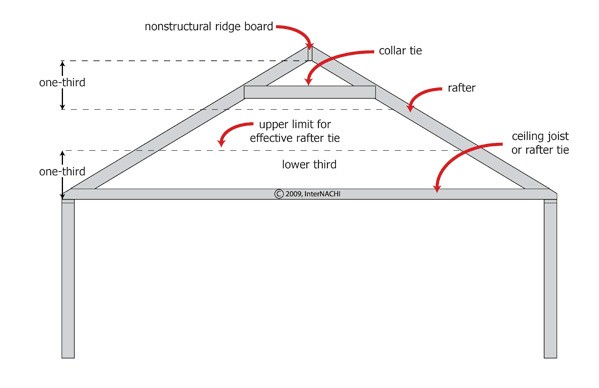
Image from NACHI
Rafter ties are located on the bottom third of the rafters, and their purpose is to prevent the walls from collapsing. They help keep the triangular shape of the roof and keep the rafters right where they are.
Without rafter ties, the rafters would be at risk of pancaking from the weight on the roof. This could be due to a heavy snow load, excess roofing material, or anything else that puts extra pressure on the roof.
When the excess weight pushes down on the roof, the rafter ties pull it together. Not all roofs have rafter ties, so in many cases the ceiling joists double as rafter ties. This is actually a fairly common practice since you don’t really need both ceiling joists and rafter ties.
What are collar ties used for?
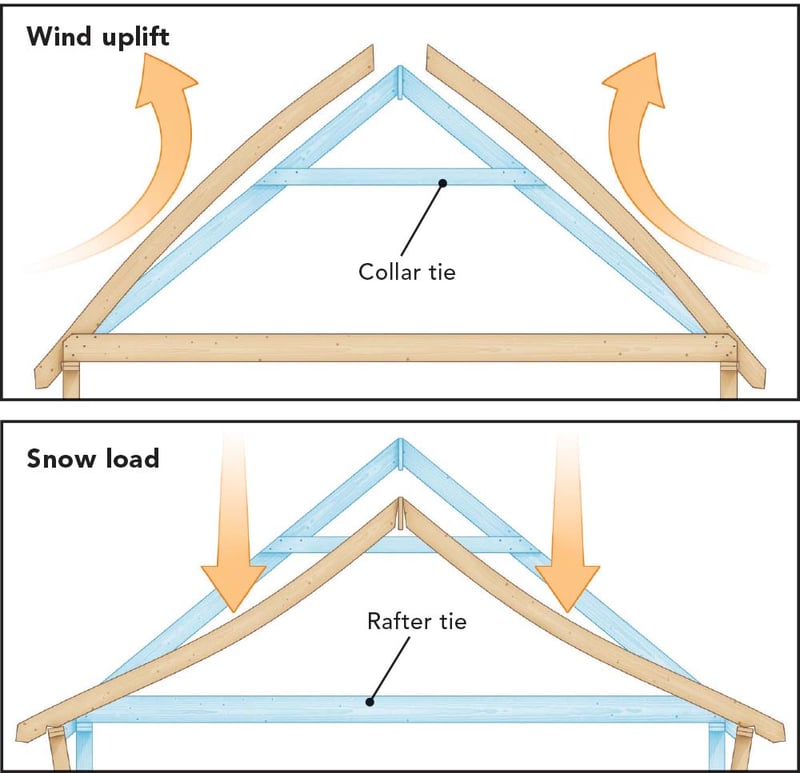
Image from Fine Homebuilding
Collar ties are located on the top third of the rafters, and their purpose is to prevent wind uplift from pulling the rafters apart.
You can get a lifting effect when the wind blows across the roof (this is also known as the Bernoulli effect). In heavy winds, if there is no collar tie on your roof, it could be torn apart. It is meant to hold the top of the rafters in place when the lift effect from the wind happens.
Collar ties are always supposed to be included when you are installing the rafters without pre-manufactured trusses.
Some homeowners want to remove their collar ties to make space for an attic remodel. This can be done safely if you add extra precautions in their place. However, you should always consult an engineer before making changes to your roof framing.
How do I know if my roof needs rafter ties or collar ties?
If you’re using pre-manufactured trusses, then you don’t need to worry about this because they have their own specific structure that replaces rafter and collar ties. However, if you have a stick-framed roof, then you need both rafter ties and collar ties.
Pre-manufactured trusses come in many different styles, but they all include supports in the middle that do the same kind of job as rafter and collar ties. For example, on this roof we installed a few new trusses:
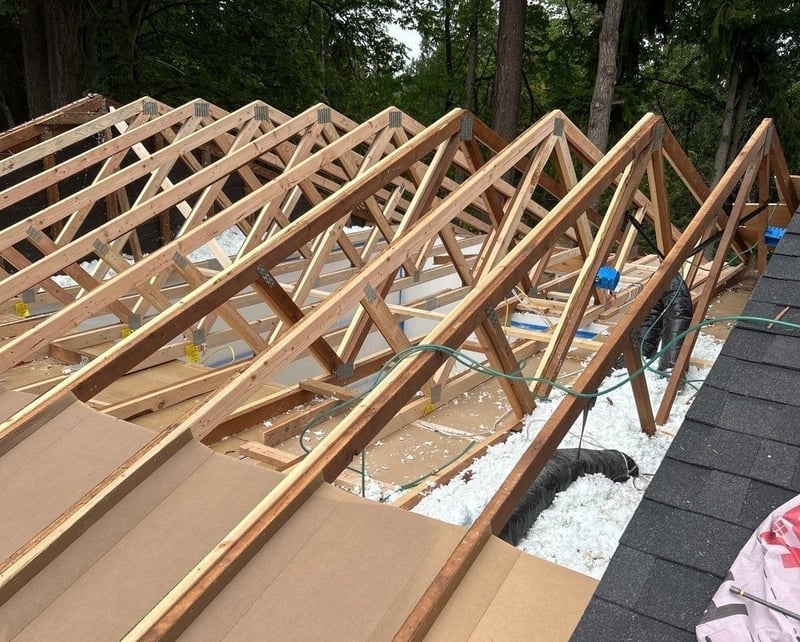
Depending on the structure, you might notice that the roof only has rafter ties (or vice versa). Most of the time, we only see collar ties installed, and the ceiling joist is acting as the rafter
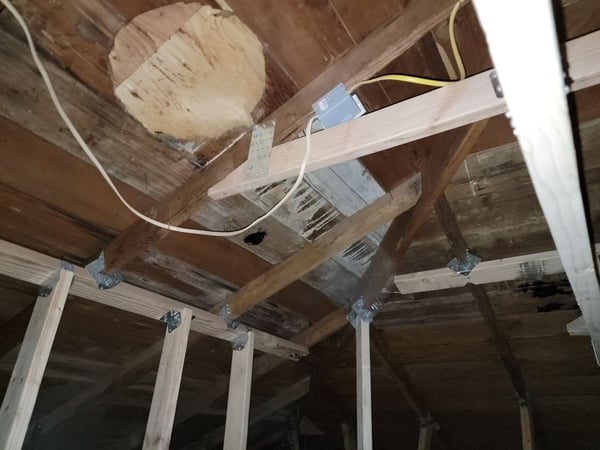
But if the roof is missing collar or rafter ties and doesn’t have any alternatives, then the roof is underframed and potentially at risk.
If your roof has any of the following issues, your roof might need rafter or collar ties (or both):
- Roof is sagging
- Walls are bowing
- You’re worried your roof might collapse
There are a fair number of homes in the Seattle area with framing problems that cause these same issues, so it’s important to hire a professional to diagnose your roof’s specific issues and ensure compliance with building codes.
What do I do if my roof is missing rafter ties or collar ties?
If you notice that your roof is sagging and you check the attic to find that your roof is missing either rafter or collar ties, you should call a roofer who is experienced in framing or a building science engineer.
If your roof is underframed, then it’s going to take a lot of work to fix it. Ideally, if you notice this problem, it will line up with your roof needing to be replaced because you’ll need to tear the whole thing off to fix the framing underneath.
This will be a long and expensive process, but in the end you’ll have a safe, structurally sound roof.
It will include:
- Tearing off your roof
- Removing your old framing (unless the plan is to keep some of it)
- Installing new framing
- This can be stick framing or trusses, depending on what your engineer decides
- Installing the new roof
The entire process will take at least a few weeks (possibly more, depending on the scope of the project) to complete and will cost at minimum tens of thousands of dollars.
At RoofSmart, we are experienced in framing and carpentry, so we have helped many customers fix the framing on their roof. Sometimes it’s a simple fix that we can figure out for you, while other times you’ll need to hire a professional engineer to redesign your roof’s framing.
How can RoofSmart help with a roof redesign or structural framing project?
Understanding the difference between collar ties and rafter ties is about more than learning roofing terminology. It's also about protecting the structural integrity of your home.
Whether you're planning an attic conversion, replacing an aging roof, or investigating signs of sagging or bowing walls, removing or modifying these framing members without the proper design can create serious structural problems.
The good news is that missing or inadequate framing can often be corrected. The key is working with a contractor who understands roof framing, knows when an engineer should be involved, and can safely rebuild the roof to meet modern building codes.
Read our article “Why Choose RoofSmart to Help With Your Roof Redesign Project?” to learn how RoofSmart approaches complex roof redesigns, why framing and building science expertise matter, and what to expect if your project requires structural modifications before a new roof can be installed.

Frequently Asked Questions About Collar Ties and Rafter Ties
1. What is the difference between a collar tie and a rafter tie?
Although they're often confused, collar ties and rafter ties serve different structural purposes. Collar ties are installed near the top of the rafters to resist wind uplift, while rafter ties are installed near the bottom to prevent the walls from spreading outward under the weight of the roof.
2. Does every roof have collar ties and rafter ties?
No. Homes built with prefabricated roof trusses typically do not use traditional collar ties or rafter ties because the truss system is engineered to perform those structural functions. Stick-framed roofs, however, often require one or both depending on the design.
3. Can ceiling joists act as rafter ties?
Yes. In many homes, the ceiling joists are attached to the bottoms of the rafters and serve the same purpose as rafter ties by resisting the outward force that pushes exterior walls apart.
4. What happens if a roof is missing rafter ties?
Without adequate rafter ties or an engineered alternative, the weight of the roof can push the exterior walls outward over time. This may result in:
- Sagging roof ridges
- Bowing exterior walls
- Cracked drywall
- Structural movement
- In severe cases, partial roof failure
5. What happens if a roof is missing collar ties?
A roof without collar ties may be more vulnerable to wind uplift. During strong wind events, the rafters can experience upward forces that may separate the roof framing if no properly designed uplift resistance is present.
6. Can I remove collar ties to create more attic space?
Possibly, but only after consulting a structural engineer or qualified framing professional. Removing collar ties without providing an engineered replacement can weaken the roof structure and create serious safety issues.
7. How can I tell if my roof framing has structural problems?
Common warning signs include:
- A sagging roof ridge
- Bowing or leaning exterior walls
- Cracks in ceilings or drywall
- Doors or windows that suddenly stick
- Visible movement in the roof framing
- Missing or damaged framing members in the attic
A professional inspection is the best way to determine the underlying cause.
8. Can missing collar ties or rafter ties be added later?
Yes. Depending on the roof's design, contractors may be able to install new framing members or engineer alternative structural reinforcements. The best solution depends on the home's existing framing and any planned renovations.
9. Why don't roof trusses need collar ties or rafter ties?
Roof trusses are engineered as complete structural systems. Their internal web members distribute loads differently than traditional stick framing, eliminating the need for separate collar ties and rafter ties in most designs.
10. How much does it cost to fix missing roof framing?
The cost depends on the extent of the structural work. Simple framing corrections may be relatively straightforward, while extensive repairs involving roof removal, reframing, engineering, and roof replacement can cost tens of thousands of dollars. Because framing repairs often require removing the roofing materials, many homeowners choose to complete them during a full roof replacement to minimize future labor costs.
Topics:
