

TL;DR: Summary
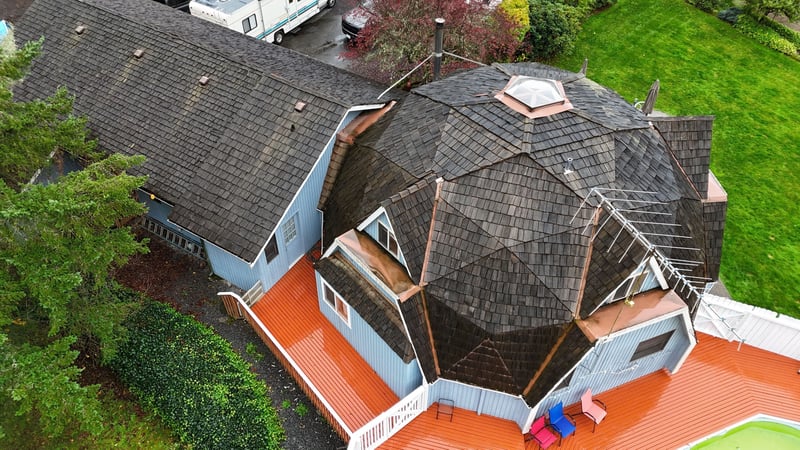
Replacing a roof on a geodesic dome is more complicated than a standard roof replacement because the dome cannot use traditional attic ventilation and has many different angles. For Seattle-area geodesic domes, cedar shakes or shingles are generally the best roofing option because they can breathe without traditional attic ventilation and can be installed across the dome’s changing slopes.
Installation requires skilled roofers to work from the bottom up, carefully cutting the cedar into the dome’s triangular sections. The flatter area at the top may require additional waterproofing or a flat roof membrane. This specialized labor, scaffolding, and premium cedar make the project expensive. In the example discussed, the geodesic dome alone would cost about $100,000 to reroof. Asphalt may cost less initially, but without proper ventilation, it can fail prematurely and may not qualify for the manufacturer’s warranty.
The key takeaway: Cedar shakes or shingles are the better long-term roofing choice for a Seattle geodesic dome because they can perform without traditional attic ventilation and accommodate the structure’s unusual angles. Expect the project to cost significantly more than a conventional roof because of the specialized materials, cutting, access, and labor required.
Do you own a geodesic dome and feel overwhelmed trying to find a roofer who actually knows how to replace such an unusual roof? Are you worried about spending tens of thousands of dollars or more on a new roof only to discover that the material you were sold could fail years earlier than you expected?
At RoofSmart, we know a geodesic dome can’t be approached like a conventional Seattle roof. Its lack of traditional attic ventilation, constantly changing angles, flat areas, and triangle-shaped sections all affect which materials can be used and how the roof needs to be installed. Choosing the wrong system could leave you with a much shorter roof lifespan and potentially no manufacturer warranty.
In this article, I’ll explain which roofing materials work on a geodesic dome, why we recommend premium cedar shakes or shingles instead of asphalt, and what you could expect to pay for a replacement in the Seattle area.
Geodesic Dome Roof Replacement: Material and Cost Comparison
|
Category |
Premium Cedar Shake/Shingles |
Asphalt Shingles |
Flat Roof Membrane |
|
Suitable for an unvented geodesic dome? |
Yes |
No, based on the ventilation requirements discussed in this article |
Yes, for appropriate low-slope/flat sections |
|
Traditional attic ventilation needed? |
No |
Yes |
Depends on the roof assembly |
|
Handles changing dome angles? |
Yes; can accommodate a wide range of angles |
Physically possible to install, but ventilation creates a major performance concern |
Best suited to the flatter portions |
|
Expected lifespan on a dome |
About 40–50 years for pressure-treated premium cedar as described here |
About 12–15 years on an unvented dome, based on RoofSmart's experience |
Depends on the membrane and assembly |
|
Manufacturer warranty concern |
Appropriate cedar product should be selected for the application |
Asphalt warranties may require ventilation, potentially leaving an unvented installation outside warranty requirements |
Product-specific requirements must be checked |
|
Installation difficulty |
Very high |
High because every section still requires custom cuts |
Specialized installation on flatter areas |
|
Approximate dome-only cost in this example |
About $100,000 |
About $50,000 |
Not provided |
|
Why installation is expensive |
Skilled labor, extensive cutting, unusual geometry, scaffolding, and premium material |
Complex geometry, custom cuts, and access requirements |
Depends on location and roof design |
|
Best use on a geodesic dome |
Primary roofing material |
Not recommended in this article |
Potential option for the flat section at the top |
|
Primary advantage |
Breathability, longevity, and ability to handle the dome's unusual angles |
Lower upfront cost |
Strong waterproofing for low-slope areas |
|
Primary disadvantage |
Very high upfront cost |
Shorter expected life without proper ventilation |
Doesn't provide the same appearance as cedar |
|
RoofSmart's recommendation |
Premium treated cedar shake or shingles |
Avoid on an unvented dome |
Consider for the very top if additional waterproofing is desired |
Which material is best to use on a geodesic dome roof in the Seattle area?
Geodesic domes are not vented, so you need a roofing material that can survive without traditional attic ventilation. This immediately eliminates everything except cedar shakes or shingles.
All other materials need ventilation, meaning that you CANNOT use the following materials:
- Asphalt shingles
- Metal
- Euroshield (and other synthetic materials)
These materials NEED attic ventilation. Without it, the roof will get too hot, and the roofing material will fail prematurely.
Cedar shakes and shingles can breathe without standard attic ventilation, so they'll hold up just fine on a dome. They can also be installed at just about any angle.
Geodesic domes have all kinds of angles, ranging from completely flat to extremely steep:
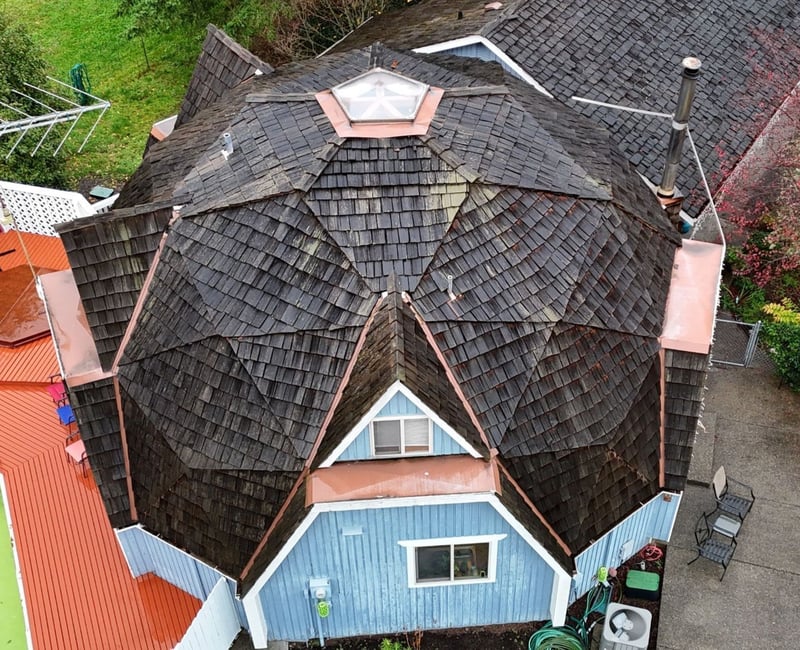
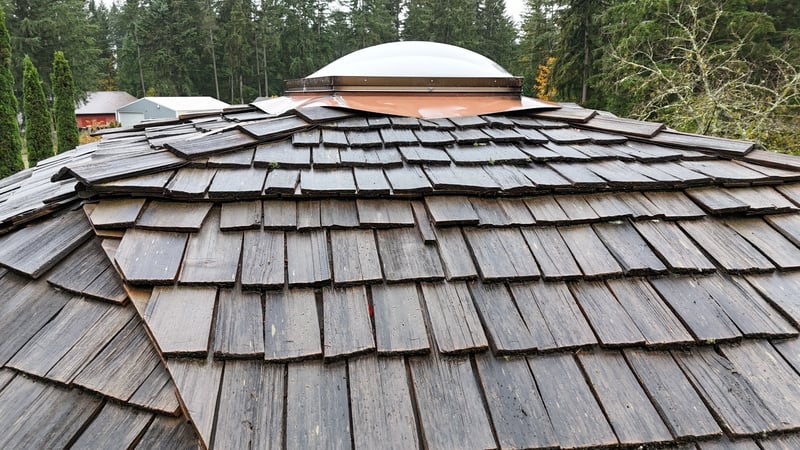
And then, when you get up to the top part that gets completely flat, you can do a flat roof material. Or you can do ice and water shield followed by cedar breather (so that it sits off of the ice and water shield just a little bit), and then you can put the shakes on.
Or you could put a flat roof membrane on there if you're really nervous about it.
That's going to be much more waterproof, and when it’s at the very top, you can't see it because it tends to get fairly shallow up there.
It is impossible to vent a geodesic dome. So if you can't vent it, then it's not going to last very long (15 years, in most cases) with an asphalt roof. If you have an unvented deck, what that means is that no asphalt manufacturer will warranty that roof.
Some roofers will try to offer you a good deal by saying they can put asphalt shingles on for a lower price. But of course, the people who are telling you that it's fine to do asphalt are not saying it's only going to last 12 years (which it will), nor are they going to tell you that the 50-year warranty that they’re offering is voided if you don’t have proper ventilation.
How much does it cost to replace the roof on your geodesic dome in Seattle?
In Seattle, this roof (the garage and dome) would cost $150,000 to install. Just the geodesic dome would cost $100,000. This range includes labor and materials.
The reason the replacement cost for the geodesic dome is so high is that it takes a lot of skilled labor to install the roof, plus the fact that the roofing crew would have to set up all the scaffolding to be able to access the roof.
On top of that, premium cedar shake or shingles with a protective coating cost a lot as well. If you get a lower grade of cedar shake, then you might save some money, but your roof won’t last as long (and it will still be expensive overall).
They're not making any new versions of these geodesic domes because they are so expensive to build and maintain. These are out there, and they tend to be on nicer pieces of property because it costs more to build.
The cost of fixing these, especially the roof, is so high now with labor costs being what they are; it’s cheaper to tear down.
So you can imagine people swallow hard when they hear that it would be $100,000 to do it in cedar shakes or shingles. And they wonder if they can find somebody that'll do it for less. Well, of course you can. You can put asphalt on there for about $50,000 and then have to replace it again in 12 years.
It's bad math, because you can do pressure-treated shake for twice as much and get 40 to 50 years out of it (over 3x as long as asphalt shingles will last).
How do you install a roof on a geodesic dome?
Basically, what the roofer does is start at the bottom and work their way up while installing shakes or shingles in a triangle pattern. So you put the shakes on, then you come by with your saw. You don't want to go too deep because you cut the course below.
A lot of people approach it like it's a standard roof. And so they just ask what substrate they need or what angle it goes up or down to. And while those are important questions, it doesn't really treat it as the system that it is.
So you have sections near the bottom basically forming a wall, and then you angle up, and you've got these diagonals everywhere, because it's made out of triangles. And everything has to be cut by hand to make the triangle shapes, no matter what material you use.
They're unique and interesting projects, and we love to do them, but they're expensive.
How Do You Find a Qualified Roofer for a Geodesic Dome Roof Replacement?
Replacing a geodesic dome roof is very different from replacing a conventional roof. It requires a lot of experience and skill that a lot of roofers do not have.
That distinction becomes especially important when you’re considering a project that could cost around $100,000 for the dome alone. A lower bid using asphalt shingles might look appealing compared with premium cedar, but the savings become much less attractive if the material isn’t appropriate for an unvented dome, has no applicable manufacturer warranty, and needs to be replaced again significantly sooner.
Before trusting a contractor with a specialized project like this, you need to know whether they have the knowledge and experience to recommend the right system (not just the cheapest or easiest material to install).
Read our article “Is Your Seattle Roofer Actually Good? Here’s How to Tell Before It’s Too Late” to learn what you should look for when evaluating roofers and how to determine whether a contractor is prepared to handle your roofing project correctly.
Frequently Asked Questions About Roof Replacement on a Geodesic Dome
1. What is the best roofing material for a geodesic dome?
For the Seattle-area geodesic dome described in this article, premium cedar shakes or shingles are the recommended primary roofing material because they can breathe without traditional attic ventilation and can accommodate the dome's many different roof angles.
A flat roof membrane may also be an option for the nearly flat section at the very top of the dome.
2. Why can't you use asphalt shingles on a geodesic dome?
The biggest problem is ventilation. Geodesic domes aren't traditionally vented, while asphalt roofing systems typically rely on proper ventilation to manage heat and moisture.
According to the experience discussed in this article, an asphalt roof installed on an unvented geodesic dome may only last around 12–15 years. Manufacturer warranty requirements are another concern because an unvented installation may not meet the ventilation requirements necessary for warranty coverage.
3. Can you install a metal roof on a geodesic dome?
RoofSmart does not recommend metal for the geodesic dome application described here because the dome cannot provide the traditional ventilation needed for that roofing system.
The geometry also makes a dome fundamentally different from a conventional sloped roof. Rather than evaluating a material based only on whether it can physically cover a particular angle, the entire roof assembly needs to work as a system.
4. How much does it cost to replace a geodesic dome roof in Seattle?
For the specific project discussed in this article, RoofSmart estimates that replacing just the geodesic dome roof with premium cedar would cost approximately $100,000, including labor and materials.
Completing both the dome and garage would cost approximately $150,000. These figures are examples from this particular project rather than universal prices for every geodesic dome.
5. Why is replacing a geodesic dome roof so expensive?
Geodesic domes require significantly more specialized labor than conventional roofs. The crew needs scaffolding to safely access the structure, and the dome is composed of numerous triangular sections with constantly changing angles.
The roofing material also has to be repeatedly measured and cut to fit those triangles. When you combine that labor with the price of premium treated cedar, the cost can become substantial.
6. How long does a cedar shake roof last on a geodesic dome?
The pressure-treated premium cedar discussed in this article can provide approximately 40–50 years of service when properly installed and maintained.
That's one reason RoofSmart considers the higher upfront investment more practical than installing a lower-cost asphalt roof that may need replacement much sooner because of the dome's lack of ventilation.
7. Is it cheaper to put asphalt shingles on a geodesic dome?
Upfront, yes. In the example discussed here, an asphalt roof might cost around $50,000, compared with approximately $100,000 for premium cedar on the dome.
The problem is long-term value. If asphalt lasts only around 12–15 years in this unvented application while treated cedar lasts roughly 40–50 years, the cheaper initial installation could require multiple replacements during the lifespan of one properly installed cedar roof.
8. How are cedar shakes installed on a geodesic dome?
The roofer generally starts at the bottom and works upward, installing the cedar while following the dome's triangular geometry.
Because the structure consists of triangles rather than conventional rectangular roof planes, many shakes need to be individually cut to fit. When making those cuts, the installer also has to avoid cutting too deeply and damaging the course underneath.
9. How do you roof the flat section at the top of a geodesic dome?
One approach described in this article is to install ice and water shield, followed by cedar breather and then cedar shakes. The cedar breather creates separation between the shakes and the ice and water shield.
Another option is to use a flat roof membrane on the nearly flat top section. Because that portion is difficult to see from the ground, homeowners may be able to prioritize waterproofing there without significantly changing the dome's visible cedar appearance.
10. What should I ask a roofer before hiring them to replace a geodesic dome roof?
Ask whether they've worked with unvented roof assemblies, cedar shake or shingle systems, complex roof geometry, and the scaffolding required to safely access a dome. You should also ask exactly how they plan to handle the nearly flat section at the top.
Most importantly, don't evaluate a proposal based on price alone. If a contractor recommends a less expensive material such as asphalt shingles, ask how the lack of ventilation will affect the roof's expected lifespan and manufacturer warranty. A material that costs less initially may not be the less expensive option over the life of the building.
Topics:
